Source : www.radiojamaica.com
September 22, 2009
PC overworked while CCJ under-utilized
Source : www.radiojamaica.com
September 18, 2009
Glimmer of Hope for the CCJ
The Caribbean Court of Justice
Source: CaribWorldNews, BELMOPAN, Belize,
Published: Wed. Sept. 16, 2009
By Oscar Ramjeet
There seems to be a glimmer of hope for a few more countries to join the Appellate Jurisdiction of the Caribbean Court of Justice.
After five years and five months since its establishment on April 12, 2004, no other country has joined Guyana and Barbados to make the CCJ the final court.
However Belize`s Prime Minister, Dean Barrow, tabled a Bill in Parliament three months ago to remove the Privy Council as the final court and to replace it with the regional court. And the government has been sensitizing the public on the move by holding consultations throughout the country.
Under the Belize constitution, no referendum is required to amend the constitution to remove the Privy Council and the Barrow administration has the required number of votes in Parliament for the amendment.
Last week I spoke with Grenada Prime Minister, Tillman Thomas, and he said that he will soon put mechanism in place to join the regional court. In fact he spoke to officials of the Grenada Bar Association on the issue and they are supporting the move.
While attorneys general and senior law officers were meeting in St. Georges, two regional luminaries in the region Professor Simeon Mc Intosh, Dean of the Cave Hill Campus of the University of the West Indies and Professor Winston Anderson of the Caribbean Law Institute, were educating Grenadians on the benefits of the regional court.
Dominica Prime Minister, Roosevelt Skerrett has also announced his intention of joining and it appears that the St. Lucia government is heeding a call from opposition leader, Kenny Anthony, for that country to join.
St. Lucia`s Attorney General, Nicholas Frederick, indicated to me that he is in the process of taking steps to put the required machinery in place to remove the British based Privy Council as the final court.
Meanwhile, in St. Vincent and the Grenadines, Prime Minister Ralph Gonsalves, is pushing for his country to join the regional court, but the multi-island state needs a referendum on the present constitution in order to remove the Privy Council as the final court.
However, the government has decided to overhaul the entire constitution in order to facilitate the court, and at the same time they have decided to make some rapid changes, including replacing the prime minister by an executive president and introducing proportional representation among other changes.
But it is very unfortunate that there has been no word from the two big countries, Trinidad and Tobago and Jamaica, which were in the forefront when the regional court was first advocated for 20 years ago.
Suriname`s Ambassador to Caricom, Manorma Soeknandan, who was in Grenada for the law conferences, told me that Suriname has to put several things in place before it can join. While an eminent Caribbean lawyer, Dame Dr. Bernice Lake, an Anguilla attorney, said that the regional governments disenfranchised the public when they set up the CCJ without referenda.
The CCJ was established by CARICOM member states not only as the final Court of Appeal replacing the Privy Council, but to resolve disputes between Caribbean countries which are parties to the revised Treaty of Chaguaramas.
Although Antigua and Barbuda, Bahamas, Grenada, Dominica, Jamaica, Trinidad and Tobago, St. Kitts and Nevis St. Lucia. St. Vincent and the Grenadines and Suriname have not yet accept the CCJ as their final court, they can nevertheless use the CCJ to deal with treaty matters and international legal issues, but after 65 months only about three CSME issues reached the CCJ.
I sincerely hope that before too long, nearly all the states which signed the treaty, will make full use of the regional court.
September 15, 2009
OECS Lawyers back CCJ
OECS lawyers back Caribbean Court
Source: Dominica News
Published: September 14, 2009
September 14, 2009
Endorsing the CCJ
Endorsing the CCJ Rickey Singh Source: Trinidad Express Sunday, August 30th 2009 |
THIRTY years after becoming an independent nation, the Eastern Caribbean island of St Vincent and the Grenadines is gearing for a national referendum that could also remove a constitutional burden to access the Caribbean Court of Justice (CCJ) as its final appellate institution instead of clinging to the apron string of the British Privy Council. This could well be seen as a case of finally putting the proverbial cat among the pigeons. Setting, as it does, the political precedent for other countries of the Organisation of Eastern Caribbean States (OECS), as well as Jamaica and Trinidad and Tobago to do likewise. Some of these countries also require either a two thirds parliamentary majority or endorsement by a national referendum to facilitate ditching the Privy Council in favour of the CCJ. The Vincentian parliamentary opposition New Democratic Party (NDP) of Arnhim Eustace, a former short-term Prime Minister, has already vowed to vigorously campaign against a "yes" vote at the referendum scheduled for this coming November. For his part, Prime Minister Ralph Gonsalves, whose governing Unity Labour Party (ULP) already holds a dominant 12-3 parliamentary majority, has warned of a "spirited campaign" to win endorsement of a draft new constitution that provides for a two thirds majority to amend entrenched constitutional provisions. For different reasons, neither the government of Jamaica's Prime Minister Bruce Golding nor that of Trinidad and Tobago's Patrick Manning, is in the mood at present to consider a referendum to endorse constitutional changes to replace the Privy Council with the CCJ-an issue over which members of the legal profession in both countries are also in disagreement. In the case of Jamaica, the opposition People's National Party (PNP), which has always been supportive of the CCJ, will pose no problem whenever the Golding administration chooses to demonstrate serious interest in ending the dispensation with the Privy Council in favour of the now more than four-year-old regional court. However, in Trinidad and Tobago, where there continues to be controversies-some quite fierce and disturbing for a parliamentary democracy-the government of Prime Minister Patrick Manning cannot look forward to any support from the parliamentary opposition United National Congress-Alliance (UNC-A) to have the CCJ as the country's final court of appeal. For even in their current bitter internal conflicts the warring factions of the UNC-A continue to harbour deep reservations over the independence of the local judicial system and, regrettably, seem disposed to extending such concerns-without evidence-to the CCJ which, ironically, has its operational headquarters in Port of Spain. This scenario clearly suits Prime Minister Manning, affording him the comfort to openly lament the country's failure to cut ties with the Privy Council, while pursuing no serious initiative to have the CCJ as the country's final appellate institution, for example, in forcing opposition parties to vote for or against the CCJ, or making it a national referendum issue-as now being done in St Vincent and the Grenadines. More than four years ago, on April 16, 2005 to be precise, the CCJ was inaugurated amid pomp and pageantry in Port of Spain, following settled arrangements for its service to Caricom as a final court of appeal for participating countries as well as serving with original jurisdiction in resolving trade disputes arising from interpretation of the Revised Treaty of Chaguaramas. At the time of its ceremonial inauguration, Barbados and Guyana were the only two member countries no longer tied to the Privy Council, even as Trinidad and Tobago, the operational headquarter of the CCJ, continued to engage in mere platitudes about its importance. Today Barbados and Guyana are still the only two Caricom countries that are members of the CCJ, soon to be formally joined by Belize now under the leadership of Prime Minister Dean Barrow. Now seems a good time to ask whether it is fear of not obtaining required parliamentary majority approval or-as is also necessary in a few cases-the endorsement of a national referendum that stands in the way of accessing CCJ membership as their final court? Or is it more a case of lack of conviction by some governing political directorates to terminate an inherited colonial dependence on the Privy Council, in favour of the competence and integrity of the CCJ? There are examples, and not only involving penalty cases, where both governing and opposition parliamentary parties have expediently referenced to prolong vacillations in accessing CCJ membership. In so doing, they can hardly be unaware of a preference to demonstrate more faith in the judges of a dwindling Privy Council than in the independence, competence and integrity of the judges of our regional court. |
CCJ Likely to solve WICB
CCJ likely to solve WICB-players dispute
Source: Cricketnext.com Posted on Sep 05, 2009
Jamaica: The Caribbean Court of Justice (CCJ) is likely to settle the dispute between the West Indies Cricket Board (WICB) and its players, which has come to a standstill after the talks broke down at the last moment during the mediation.
"With talks breaking down at the last moment during the mediation, the issues will now have to be taken to the Caribbean Court of Justice for arbitration," WICB's external legal counsel, Derek Ali, told a press meet on Saturday.
The WICB had defended itself in the aftermath of the claim made by mediator Shridath Ramphal that the late addition of a new set of requirements by the board had resulted in the failure to settle the differences.
Ramphal had earlier said that the attempt to find a solution had failed after the WICB produced "an alternative document" during negotiations, which was unacceptable to the WIPA. The claim, however, was refuted by the board's industrial relations consultant, Gerald Pinard, who said the WICB had done nothing wrong by sending the document to Ramphal.
The new move is the latest development in the impasse which has engulfed West Indies cricket over the last month and resulted in under-strength squads being selected for the recent Bangladesh series and the upcoming Champions Trophy in South Africa.
Star performers like Chris Gayle, Shivnarine Chanderpaul and Ramnaresh Sarwan opted out due to pay and contractual disputes.
"WICB has heard talks that we sent in a document that derailed the process and we walked out," Pinard has been quoted as saying in the local media.
"This is surprising to hear because what we sent in was a draft agreement outlining what was agreed upon and what was to go to arbitration. This document sent to Ramphal on August 31 was not much different from the first one we sent in on August 29," he added.
July 28, 2009
Brazilean appeals for change in Constitution to adopt CCJ
Published on Thursday, July 23, 2009
Source: Caribbean Net News : Print Version
Belizeans living abroad, including myself, are strongly in support of these two amendments because one will reaffirm the constitutional rights of Belizeans who possess dual citizenships and the other will have a major impact on the reduction of murders in Belize by resuming capital punishment, which the Privy Council in London seems to be ruling against persistently over the years.
July 15, 2009
Swim together or sink separately
Caricom Summit: Swim together or sink separately by:Andy Johnson Wednesday, July 15th 2009 Source: Trinidad and Tobago Express |
IT was billed as Caricom's make or break summit. One comment also described it as another attempt by the region's political leaders to address "an ever increasing list of unresolved issues". When he spoke at the opening ceremony at which he was conferred with the region's highest award, the former Jamaican Prime Minister P J Patterson also talked in dark tones, weighing the prospects for the region's survival against the possibility that the regional integration project was foundering. Swimming together or sinking separately was another one of the end-game analogies being used to convey the impression of a movement approaching the rock of disintegration. With an article appearing in the online Caribworld news, David Jessop concluded by suggesting that "if the Georgetown Summit, Caricom's 30th regular meeting of Heads of Government, failed to result in "decisions that are implemented, it will be hard to avoid the sad conclusion that the age of pan-Caribbean regional integration is passing". Armed with the communiqué issued at the end of the Georgetown Summit on the morning of July 5, Mr Jessop and others are in a position now to assess the extent to which the decisions taken there were sufficiently implementation friendly to avoid the catastrophe they envisage. Many of those decisions, frankly, leave much to be desired on some of the key issues facing the countries involved in the "Caricom project," the term now adopted as flavour of the month. With expectations aplenty among many of the region's well wishers along with the dependants of its best deliberations, on the issue of "Agriculture and food security", the leaders "reaffirmed" the following. "Their commitment to providing financial and other support measures for agriculture. They underscored the importance of agriculture for food and nutrition security and for the development of our economies." They issued a separate declaration on the matter as well, but which itself requires further, detailed examination.. On Tourism, the lifeblood activity for many of the economies in the region, this is what they said. "Heads of Government also considered the impact of the global economic and financial crisis on the tourism sector and agreed that implementation of the Regional Marketing Programme was urgent." They also agreed to pursue with the government of the United States the establishment of more pre-clearance facilities in the Caribbean. And they resolved to pursue with the government of the UK the proposed Air Passenger Duty, and matters related thereto. Many of the region's peoples and organisations hanging on for every word that would have come from the meeting on these issues could well be left wanting more. After hearing also a report on an audit of the Caribbean Single Market and Economy, with all that is critical in this for the movement's very survival, the leaders agreed to hold convocation with all the stakeholders, to give full consideration of that report. This was the first of three short statements on this item. But with his own back against the Georgetown summit's wall over his government's new immigration policy, it was the Prime Minister of Barbados who came out firmly against those who would see only gloom over the Caricom cloud. And against those who remain merely cynical or apprehensive about the future. He saw a past full of achievements, from which a prosperous future should easily be imagined. From where he stood, he told reporters at a news conference on July 1, "You have to understand your past in order to sensibly shape your future. You have to understand the historic context of the long and arduous journey, started by that great generation of West Indian leaders, which took us from colonialism, through the Federal experiment, to Carifta". And beyond. "You have to measure the way forward by acknowledging the way already travelled," he said, declaring that it was easy for stakeholders, in times of crisis, to become impatient at what they see as the slow pace of the integration project, and to declare it dead on arrival. When one looked dispassionately at what has happened in the region over the last four decades since independence began in the 1960's David Thompson said the region confronted formidable odds. It was difficult, in those circumstances, he said, "to understand the pessimism and the talk of failure". He had traced that journey over some 40 years, surveying both the state of the world and of the region, stopping at points along the way, in 1969, and 1989, to emphasise his focus. Twenty years ago for instance, he reminded those who would listen, the world was in turmoil and the region was feeling the impact of that. He quoted Michael Manley at the Grand Anse summit that "crisis, stagnation and economic recession had been the permanent bedfellows of Caricom since its inception. This, the late former Jamaican Prime Minster had said, produced a "long period of near-retreat from strategic purpose". But coming out of the Grand Anse summit was the decision to go for a revision of the community establishing Treaty of Chaguaramas, therein the call for the establishment of the CSME and the setting up of the West Indian Commission. Over this period also, Thompson listed some of the achievements, many so taken from granted they would not be heralded, their impact blunted by their very fit with regional expectations. In 2009, he said, the region was once again faced with global economic convulsions of unprecedented proportions. Not so daunting, however, as to cause any revision of his conviction "that regional integration is the last best hope for the Caribbean". He worried, nevertheless, about "fragmenting into unworkable reconfigurations of the regional project, saying concentration should be on "strengthening the core, not on proliferating the periphery". Railing a current clamour for instant results, notwithstanding inherent complexities or difficulties in the external environment, he cautioned against pessimism over the CSME project. "All the provisions on the right of establishment, and the free movement of goods, services, capital and skilled persons are being implemented," he said pointing to the unacknowledged "realities". Conceding that the CSME timetable "may have been delayed," recent developments in the region have shown the true extent of the financial interdependence that already exists among us," he urged. They have given new urgency to the policy co-ordination efforts of the region's regulators and Ministers of Finance. The Regional Negotiating Machinery for him represents "a unique institution in the developing world", one that is "highly regarded internationally (and) had helped us to conclude an Economic Partnership Agreement with Europe and is preparing the groundwork for the start of talks with Canada". In the area of functional co-operation, Thompson remains convinced, "Caricom's significant achievements have gone almost unheralded". Such institutions as the UWI and the Caribbean Examinations Council are now so much a part of the region's fabric of everyday life, "we do not register them as components of the integration process". There exist harmonised systems in education, health, on climate change, disaster preparedness and response, standards and quality, competition, crime and security. And perhaps most significant of all, he said, has been "the coming into being of the Caribbean Court of Justice". Within all of this, for him the issue of free movement was simply one which has generated perhaps "the greatest heat but least light", one that is fundamental but around which "much confusion and misunderstanding persists" |
July 12, 2009
T& T Law Association on Justice Hayton
Politics: raw and refined by: Selwyn Ryan Source: Trinidad Express Sunday, July 12th 2009 |
.........( edited for relevance)..... The Law Association was involved in another controversy, this time one involving a senior judge. Justice David Hayton, an English member of the Caribbean Court of Justice, was reported to have said that the Prime Minister of Trinidad and Tobago has too much influence, more indeed than the Prime Minister of Britain who did not have the power to veto nominees for hundreds of senior state officers. Hayton also said that given the power which the Prime Minister had, he did not see the need for him to become Executive President. He remarked further that in his role as party leader, the Prime Minister also determined who contested elections and who could not. In that regard, the leader of the PNM has more power than the parties in England. (Express, July 3, 2009) These were weighty observations and the Law Association censured the judge, and rightly so. As it said, "like all other citizens, judges are entitled to freedom of expression. In expressing that right, a judge must conduct himself in such a manner as to preserve the dignity of his office and the impartially and independence of the judiciary." Justice Hayton clearly descended into the political thicket by the comments he made. Many however indicated that while the judge was not politically correct, he spoke the truth and applauded his remarks. I too agree that the PM has too much power and that his wings need to be politically clipped.Those battles however have tobe fought in different theatres. |
July 11, 2009
Eastern Caribbean Integration
Eastern Caribbean integration byJohn Spence Source: Trinidad ExpressThursday, July 9th 2009 |
I have as yet made only a preliminary examination of the Trinidad and Tobago-Eastern Caribbean States Integration Initiative Task Force Report. With respect to the matters discussed in the report I am a lay person. However, in view of the importance of such a possible development as is proposed in the report the issues should be understood by all citizens. My first difficulty is to understand the language used since it is of a discipline with which I am unfamiliar. Is it social science, foreign relations or economics? In the Task Force Report use of the word "space" extends beyond physical space (such as discussion on Human Resources space). I address first the governance structures proposed, starting with the geographic areas being considered. Under "Priorities of External Relations" the report suggests that countries of the Eastern Caribbean (including Barbados) and Trinidad and Tobago will need to organise a more coherent relationship among themselves and that this grouping will also need to sustain a balanced set of relationships with Guyana and Suriname. As recognised in the report these latter countries have large land masses and can thus provide food security and in future provide markets as they industrialise. In a previous article (Express, June 26) I referred to such possibilities and gave a specific example of how Trinidad and Tobago could start this process by investing in aluminium smelting in Guyana. It seems to me that the most important proposals in the Integration Initiative Report are: (1): "enabling legislation" which is to be enacted in each Parliament which would cause legislation "enacted" by the super-national bodies (the nature of which I shall discuss subsequently) to automatically become law in the individual countries and (2) the fact that the populations of the various countries will not be involved directly in these super-national bodies which will be composed of heads of government of the various countries and their nominees. Thus in spite of the size of the population of Trinidad and Tobago the head of government of Grenada (which has a much smaller population) will have an equal vote in decision-making as the head of Government of Trinidad and Tobago on issues that could have far reaching consequences for the citizens of this country. The Task Force recognises this issue and proposes "consultations" with civil society. Having attended many such consultations I consider that this system has no merit to address this issue. With respect to enabling legislation the most important issue for this country will be: can such legislation be passed with a simple majority in Parliament? If it can: what will the position be if legislation is passed by the super-national body which, had it been presented directly to our Parliament, would have required a special majority? I shall now attempt to set out the structure of the governance bodies as I interpret the proposals in the organisational charts shown in Appendix I and Appendix II of the Task Force Report. Model I (Appendix I): The Union (of Trinidad and Tobago and the Organisation of Eastern Caribbean States) shall consist of three arms: executive, legislative and judicial. The executive arm consists of: Council of States (heads of government of the members of the union); Council of Ministers: (Ministers of the member states of the union in relevant subject matter); Union Commissioners (Commissioners-one from each Member State of the Union); Inter-State Committees (on different subject matters) The quasi-legislative arm consists of: House of Assembly (Representatives from the Government and Opposition of each member state of the union); social compact arrangements (including representatives from civil society). The judicial arm shall consist of: Caribbean Court of Justice (Exercise of Original Jurisdiction); national courts (of the member states of the union). Model ii (Appendix ii): Executive Arm: Council of States: (heads of government of the members of the union); Cabinet (of Ministers presided over by a First Minister. Ministers do not hold such office in member states); Union Departmental Ministries, Inter-State Committees (on different subject matters). Legislative arm: House of Assembly (Representatives from the Government and Opposition of each member state of the union), social compact arrangements (including representatives from civil society). Judicial arm: Caribbean Court of Justice (Exercise of Original Jurisdiction); national courts (of the member states of the union). It should be noted that the union would start with only the executive arm in Model I so the initial decisions would be taken by the heads of government and ministers nominated by the leaders. My greatest concern is that I do not see a direct involvement of citizens at the start or for that matter even as the process develops (apart from the so-called social compact arrangements). This is no doubt that this is in keeping with the present trend in Trinidad and Tobago where, in spite of rhetoric to the contrary, citizen participation is being steadily eroded. I hope that we will have an explanation, possibly from the Minister of Information, of the main proposals in the report in simple language so that citizens might be fully informed and not misinterpret any of its provisions. |
July 03, 2009
PJ's hope for CCJ
Patterson: collapse not an option
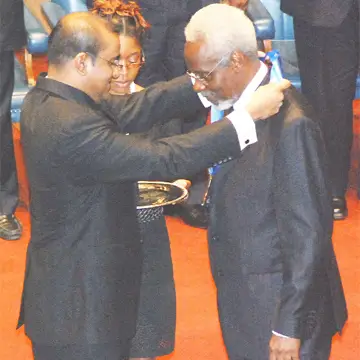
Minutes after he was conferred with the Order of the Caribbean Community (OCC), at the opening of the 30th Meeting of the Caricom Heads of Government in Georgetown, Patterson also made the long-argued case that an executive mechanism was needed to shepherd the implementation of Caricom decisions. The award – the highest within the Caribbean Community – was bestowed upon Patterson by President Bharrat Jagdeo, the new Chairman of Caricom.
President Bharrat Jagdeo (left) conferring the Order of the Caribbean Community on former Jamaican Prime Minister PJ Patterson. (Jules Gibson photo)
After receiving the award, Patterson underscored the importance of Caricom to the region and urged the current Heads of Government to do their utmost to protect the movement. During a presentation laced with similes and metaphors, he likened the Caricom movement to a plant, which needed to be properly nurtured if it were to survive. “After 36 years Caricom is still a growing plant which we must nurture. Unless we tend to the tree it will wither and eventually die”, he said.
The former long-serving Jamaican Prime Minister emphasised that the collapse or disintegration of Caricom was not an acceptable option and called on the Caricom Heads to make the institution matter to everyone. He urged the Heads of State not to abandon “the mission to improve the quality of life of the Caribbean people.”
Speaking about his own experience, Patterson said that pride and loyalty to the land of his birth have never deterred him from “becoming and remaining an unrepentant regionalist.” He said that that this particular meeting was an important one since it “is widely believed to be a meeting which will determine whether we swim safely ashore or drown separately in the Caribbean Sea.” He emphasised his belief that regional economic integration is imperative, especially if the region is to be heard globally. Patterson said that the leaders must not assume that the perpetuity of the movement is inevitable.
Patterson told the gathering that: “our own national self interest demands that we widen, deepen and strengthen the Caribbean Community, there is simply no other way out especially in these rough and perilous times”.
Patterson said that “the litmus test for effective governance is not measured by the decisions taken when heads meet, it is whether action follows.” “The greatest threat to the credibility of Caricom lies clearly in the failure to implement solemn declarations and decisions made conference after conference”, Patterson declared, adding that he himself could not be absolved of this flaw. Further, he stated that “mature regionalism will remain a pipe-dream unless authority is vested in an executive mechanism which is charged with full time responsibility for ensuring the implementation within a specified time frame of the critical decisions taken by Heads and other designated organs of the Community. For how much longer can a final decision be postponed on upgrading the institutional machinery if the community is not to become comatose?” This argument goes all the way back to the 1992 report of the West Indian Commission chaired by Sir Shridath Ramphal – who was in the audience yesterday – where an executive mechanism was recommended.
While acknowledging that the Caribbean Community had achieved success in several areas, Patterson pointed out that the challenges currently facing the community are far more daunting that those which existed at the inception of the Community. He identified the challenges of the global financial crises which he opined no state is immune from. He said that the region was no longer benefiting from the special trading regimes and protective arrangements for its agricultural products, such as sugar and bananas which it once enjoyed. He opined that that the region is “gradually being squeezed out from those areas of opportunity which globalisation and liberalization of trade were purported to allow.”
Patterson said that Caricom cannot be blamed for the difficulties that came about because of the global financial crises and said that the answer did not lie “in retreating to insularity or parochial responses.” He urged the leaders to look beyond the crises and use this experience to fuel the process of economic integration through which the productive capacity of the region is enlarged. He argued that the opportunity could be used to provide greater food security, additional processing of agricultural raw materials , energy and mineral resources, information technology , tourism, culture, sport, entertainment and other areas.
“Let us exploit new and dynamic relations with nations such as Brazil, Russia, India, China and South Africa without disturbing our relationships with our traditional partners”, he said.
Meanwhile, Patterson expressed his optimism that this conference would see the implementation of several decisions which have been so long outstanding. He urged the Heads of Government to “make the Single Market a living reality as you work towards the creation of Single Economy.” He identified as imperative the settling of issues such as the competition policy, investment and government procurement which he opined can lead to “the danger of undertaking obligations or conferring rights on external groupings which do not exist between us.”
Patterson also called on the leaders “to advance the protocol on contingent rights of skilled Caricom nationals, so that there can be greater freedom of the movement of Caricom citizens within the region.”
The former Jamaican PM also expressed hope that during this meeting that approval would be “given the Caribbean Court of Justice to do all the work which it was conceived and established and is so well equipped to undertake in providing justice for our people as the court of final jurisdiction.“ Only Guyana and Barbados have signed on to the CCJ as their final court of appeal. Belize is to join soon but Jamaica has been one of the key holdouts.
Patterson also highlighted an aspect of the Rose Hall Declaration of 2003 in Jamaica when he was PM. He said that this agreement “reaffirmed that Caricom is a community of Sovereign States but recognized from then that within such a framework, it was both legitimate and feasible for a group or groups of Community member states to forge such closer links among themselves as they collectively consider appropriate.”
CCJ Judge on Trial
Moves are being made to remove Justice David Hayton from the Caribbean Court of Justice, according to sources, following his comments in a Sunday Express interview, "Speed up Wheels of Justice".
On Tuesday, CCJ President Michael de la Bastide placed an advertisement in the Daily Express reprimanding the British law professor on what he considered to be "inappropriate and improper" public statements on "political and constitutional issues".
At a meeting that same day, de la Bastide met with Attorney General John Jeremie and the matter was discussed, and it was felt that Justice Hayton's comments had serious consequences for the CCJ, in particular how they would affect public confidence in the regional tribunal, say sources.
Justice Hayton's interview covered a wide range of issues, including the power of veto that Prime Minister Patrick Manning has in the selection of the Director of Public Prosecutions, the Commissioner of Police, the Solicitor General and the Chief Parliamentary Counsel.
He also questioned Opposition Leader Basdeo Panday's resistance to replacing the Privy Council with the CCJ as this country's final Court of Appeal, having signed up for the CCJ's establishment and going so far as to outbid Barbados for the headquarters to be here,
"It seems to me, already, under the Constitution, the Prime Minister has perhaps too much influence, so I don't see the need quite so much for an executive presidency," Justice Hayton said in the interview.
He also noted that as far as the ruling People's National Movement (PNM) was concerned, Prime Minister Patrick Manning has absolute powers over who actually stands for a constituency in an election. "And that means the leader of the PNM has much more power than the parties in England. You don't have such power vested in the leader," he noted.
On Tuesday, Attorney General John Jeremie indicated that the interview had caused great displeasure: "[Justice Hayton] has certainly stepped beyond the boundaries of ordinary judicial criticism and in a forum which is not appropriate. I know that as we speak that efforts are being made to find a resolution to that issue and I would prefer to say no more on that for the time being."
Should Justice Hayton refuse to resign, his statements are enough grounds to begin proceedings to remove him, say sources. Indeed, de la Bastide hinted at the possibility in his advertisement when he stated that Justice Hayton broke a long-standing rule that judges should not comment on political and constitutional matters, except in judgments. And the CCJ places great importance in "maintaining a cordial relationship with both the Government and the Opposition in Trinidad and Tobago", the statement said.
De la Bastide, who is a former chief justice of Trinidad and Tobago, is currently in Guyana attending a Caricom summit and could not be reached for comment. However, CCJ protocol and information officer Michael Lilla said he had no knowledge of Justice Hayton having tendered his resignation.
July 02, 2009
Let the people decide on CCJ
Perhaps the moment has arrived for the population, through a referendum, to have a say on whether or not the Caribbean Court of Justice should replace the British Privy Council as the final appellate court of T&T.
Only last week we had noted Caribbean integrationist, Sir Shridath Ramphal, unleashing a broadside against Caribbean politicians and the colonial mentality that still prevails among many, inside and outside of politics. It is this mentality of dependence, according to the distinguished Caribbean national, which prevents the region from taking the step of independence towards a court of the Caribbean making all final decisions on matters of legal justice.
Sir Shridath called it an act of “abysmal contrariety” that here is a region which has had a tradition of 100 years of “erudition and excellence in the legal profession” still hanging on to the coattails of the British court. We could add that this is true even when the court and society signalled some time ago that the time was right for the former colonial territories to establish their own independent jurisdictions.
Well, and as Sir Shridath noted, the former colonial territories of the Caribbean remain by far the largest bloc of countries (14 out of 20) still belonging to the Privy Council. While other Commonwealth countries seem to have taken the hint, we still seem addicted to the British court. Ironically, T&T, which hosts the CCJ and has the first president, a former Chief Justice and an attorney with a distinguished practice at the bar, is not able to join the CCJ in its appellate jurisdiction.
And this brings us to the major point of this editorial: perhaps we have to go the full distance to nationhood by holding a referendum to allow the population to say “yea” or “nay” as to whether we are confident enough as a people to remove one of the last vestiges of colonialism and to go on to meaningful independence.
Sure enough, Basdeo Panday, who when he was Prime Minister pushed for the establishment of the CCJ, played the contrary political game to withhold his party’s support of the CCJ now that he is no longer in office. But maybe the society can use Mr Panday’s contrariness to its benefit by holding a referendum to allow the population to decide for itself whether it should go forward.
Not only will the country, well informed, vote very deliberately and like adults about accepting the responsibility for making decisions about itself, but it will set in train a tradition which will then have to be followed by politicians and lawmakers.
That tradition will be that on fundamental issues regarding its governance, Parliament, the Government and Opposition, the Cabinet and all the leaders with state offices will have to acknowledge the right of people to decide for themselves, and not by proxy, where the country and society should go into the future.
There could not be a better moment for that kind of arousal and infusion of the participatory ethic than the present. Here now there is talk of constitutional reform and the creation of an executive president with all-pervasive powers, and all of this done through a simple majority vote in a Parliament which is not representative of at least 25 per cent of the population that consistently is not impressed with any of the political parties in the political environment.
A referendum on the Caribbean Court of Justice could set in motion that ethic of a truly participatory democracy in which people have a meaningful say in the direction in which the country develops. And maybe, just maybe, that political culture will influence the rest of the region in a similar direction.
July 01, 2009
CCJ Judge chastised by the President
President of the Caribbean Court of Justice Michael de la Bastide issued a statement yesterday reprimanding one of his own judges.
The former chief justice of Trinidad and Tobago placed an advertisement in the Express in which he chastised CCJ Judge David Hayton for the comments he made in an article, "Speed up wheels of justice", published in the last issue of the Sunday Express.
Hayton, the only non-Caribbean judge on the CCJ, "was arguably the leading authority in the UK and Europe on the law of trusts" before he was appointed to the regional tribunal in 2005, according to the CCJ's own website.
In his statement about Hayton's "inappropriate and improper" comments about political and constitutional issues, de la Bastide stated: "...I wish to make it absolutely clear that this Court espouses the well established and long standing rule that judges do not publicly comment or express views on political issues or personalities or on the merits and demerits of constitutional provisions except to the extent that they find it appropriate or necessary to do so in judgments they deliver."
De la Bastide, who is also chairman of the Regional Judicial and Legal Services Commission, which selected Hayton for the post, continued: "It is particularly important that this rule be respected by judges in relation to the host country in which their Seat is located. In so far as Hayton's comments breach this rule, they were inappropriate and improper, and I have communicated this to Justice Hayton."
Approached yesterday outside the Immigration Department on Frederick Street, de La Bastide, who was accompanied by the CCJ's protocol and information officer Dr Michael Lilla, joked: "Oh, you're the person who led my judge astray."
Asked if Hayton would be fired, de la Bastide responded: "I don't think so." However, on the matter of disciplining the former professor of law at King's College in London, de la Bastide nodded in agreement that Hayton had been severely reprimanded and replied, "Yes, as you saw today", and hurried into a waiting vehicle.
When the Express contacted the CCJ Office yesterday, Hayton's secretary said he was in a meeting. Another judge, Jacob Wit, declined to comment. His secretary relayed his message: "He says the (de La Bastide's) statement speaks for itself."
Attorney General John Jeremie said: "[Justice Hayton] has certainly stepped beyond the boundaries of ordinary judicial criticism and in a forum which is not appropriate. I know that as we speak that efforts are being made to find a resolution to that issue and I would prefer to say no more on that for the time being."
Opposition Leader Basdeo Panday, whose opposition to the acceptance of the CCJ as T&T's final Court of Appeal was one of the issues addressed by Justice Hayton, said: "I am a little frightened to appear before him now."
On why he had apparently changed his mind about replacing the Privy Council with the CCJ after out-bidding Barbados to have the CCJ's headquarters here when he was prime minister, Panday responded: "I didn't change my mind. After we had signed on, I made it absolutely clear that our replacing the Privy Council with the CCJ was dependent on the wishes of the people. I still hold to that. If the prime minister holds a referendum and the people accept it, I will certainly go along with it."
June 30, 2009
Unfinished Business with the CCJ
Source: Jamaica Observer
We don't know if Prime Minister Bruce Golding is privy to the content of a speech delivered last week by Sir Shridath Ramphal, the Guyanese former secretary general of the Commonwealth, at the inaugural conference of the Caribbean Association of Judicial Officers in Port-of-Spain.
Should the PM be, Sir Shridath's remarks ought to have reminded him that whatever else may be on his regional agenda, there is unfinished business with regard to justice and Jamaica's relationship with the Caribbean Community (CARICOM), to which his administration has to attend. For, we sense an absence of clarity on the part of Mr Golding and his Jamaica Labour Party (JLP), in its current configuration, on the Caribbean Court of Justice (CCJ).
Jamaica, we would remind, is one of the signatories to the treaty establishing the court. The US$27 million it put up to seed a trust fund to finance the CCJ represented over quarter of the US$100 million that established the account.
Jurisdictions participation
Yet, Jamaica does not participate in the court in its criminal or civil jurisdictions, although it embraces its authority in its original jurisdiction -that is, as the interpreter of the provisions of the Revised Treaty of Chaguaramas, the treaty that establishes CARICOM as a single market and economy.
The CCJ, from contemplation to inception, has been dogged, especially in Jamaica, by pragmatic questions of economics, overlaid with suspicion and political cynicism. It was juridically cheaper, and jurisprudentially safer, the CCJ's critics insisted, to maintain the Privy Council, based in London, as Jamaica's court of last resort, rather than being part of a Caribbean court, headquartered in Trinidad and Tobago.
The question of the independence and likely jurisprudential competence of the CCJ found expression, in Jamaica's case, in a legal challenge, by the JLP and others, to the constitutionality of its establishment. That challenge was upheld by the Privy Council.
Act of Parliament
The law lords held that while the Jamaican legislators, by a simple act of Parliament, could remove the unentrenched Privy Council as the island's final court, it could not similarly replace it with the CCJ. For the CCJ to be a superior court to the entrenched Jamaica Appeal Court, the Privy Council ruled, the law establishing the CCJ would have to be passed by two-thirds majority and then underpinned by a referendum.
The Privy Council's decision in the Jamaica case has constrained other countries with constitutional provisions similar to Jamaica's from proceeding to full entry into the CCJ. Only Barbados and Guyana have the CCJ as their final court for criminal and civil matters, a fact on which Sir Shridath commented.
"I am frankly ashamed when I see the small list of Commonwealth countries that still cling to that jurisdiction - a list dominated by the Caribbean," he said.
The question for Mr Golding, who was not the leader of his party at the time of the CCJ debate, is whether his party and government, having watched the performance of the CCJ for more than two years, adhere to the position that it was a bad philosophical and economic investment. After all, US$27 million is a lot of money, which Mr Golding may want to get back - at least some of it.
In any event, it is a time for a serious, balanced, non-hectoring discourse on Jamaica's place in the CCJ.