The Paradox of heritage and hesitancy
Source: Stabroek News
Address by Sir Shridath Ramphal at the Inauguration of the Caribbean Association of Judicial Officers
Port-of-Spain, June 25, 2009
(The salutations have been edited from this presentation)
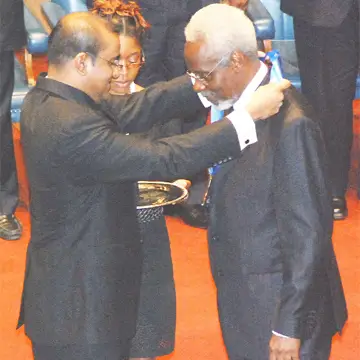
From the time we lost the Federal Supreme Court in 1962, I had dreamed of the creation of this Court as the Court of final jurisdiction in our Region, the fountain head of our jurisprudence. Thirty years later, as Chairman of the West Indian Commission, I was proud to be associated in our 1992 Report, “Time for Action,” with the conclusion that the case for the Court “with both a general appellate jurisdiction and an original regional one is now overwhelming – indeed it is fundamental to the process of integration itself.” To be invited now to give this address in the company of the Court’s judicial pioneers and other members of the judiciaries of the Caribbean, all of whom I know have shared the vision of its establishment and some of whom have worked tirelessly to secure it, is a very special honour. I thank you, Mr President, and your colleagues on the Court, from a full heart.
That it is part of the purposes of the Conference to inaugurate the Caribbean Association of Judicial Officers enhances the significance of this unique occasion of comingling. It promises continuity – a kind of Community of Caribbean Judges held together by common allegiance to the rule of law in the lands (and waters) around our Sea. That is a purpose to be extolled and encouraged. It is at least thrice blessed; in nourishing the rule of law at all levels within our wider Caribbean Region, in strengthening the capacities of Caribbean judiciaries in their role as its custodians, and in fulfilling the promise of law as the keystone of the more intimate Community we call CARICOM.
Those are purposes both lofty and practicable, inspiring and functional. Their fulfillment can make all the difference to success or failure of our regional project. Without the culture and rule of law our regionalism will wither on the vine. The Inauguration of the Caribbean Association of Judicial Officers here in Port of Spain sends a message of assurance to the Region and beyond.
The Caribbean Court of Justice
And that ‘beyond’ is significant – as the theme of this Conference acknowledges: CARIBBEAN JUDICIARIES IN AN ERA OF GLOBALISATION: MEETING THE CHALLENGES OF THE TIME. Law in the Caribbean was never just a home grown plant. Its roots lie in the Common Law of England. Its transplantation was simply one of the incidents of colonialism; and for the most part one of its better legacies. From the beginning, our law was interlaced with the legal culture of England; and beyond England as the Common Law put down roots in a far flung Empire and flourished in and was enriched by its new environments – one of which was ours. It was an era of imperialism – Pax Britannica – which was itself to pass. The trauma of the Second World War in the last Century was to make way for new eras – the era of globalization and the inseparable yet anachronistic era of an aspiring Pax Americana. Together, they provided the dominant environment of our time and the one in which Caribbean judiciaries have had to function. Meeting the legal challenges of this time is an ineluctable vocation of the Judicial Officers of today’s Caribbean – as it is of judiciaries worldwide.
Michael De La Bastide, President of the Caribbean Court of Justice
There is a temptation in small countries and regions far from centres of great power to believe that because we cannot influence events there, we can conduct our lives as if those events did not matter. It was never ever true of the Caribbean; colonialism was its antithesis; and markets for our production of sugar and later bananas meant that the world beyond always was very relevant to us. The era of globalization simply smothered any temptation to think otherwise. But the new era did more than confirm our primordial needs; it enlarged and extended them and changed them qualitatively. Our two dimensional world had gone global affecting not only us but also all others on the planet. And basic to that change was law. That is the essential truth our profession must grasp.
Thirty-two (32) years ago, in 1977, speaking to Commonwealth lawyers in Edinburgh (at the 5th Commonwealth Law Conference) I alluded to this change in words that I think remain apposite. I said then, and repeat to you today:
It is simply no longer possible and never was justifiable for an ethos of social and economic justice to stop at national frontiers. Nationalism and sovereignty, for too long a masquerade of national bigotry and self-aggrandizement, must now give way to internationalism and interdependence – and not just for moral reasons related to our spiritual health, but for practical reasons related to our planetary survival…
Commonwealth lawyers – heirs to (a) great tradition of fashioning a new jurisprudence out of the rigidities of the old – should be in the forefront of a movement that will fashion a new world legal order for the twenty-first century. Great challenges are already at hand in such frontier areas as the international commons….But, as the law of the sea dialogue confirms, these challenges will only be met by new systems and structures when we make the essential conceptual breakthrough about the nature of the human condition; when we acknowledge that the vision of one world has become the reality of one human community. It is worth remembering that Lord Atkin’s catalytic formulation of the duty to take care could only have entered a jurisprudence already sensitized to the concept of ‘neighbour’.
All this is a part of the new global ‘equity’ of which I speak – a consciousness that each man – not just each fellow citizen – is our neighbour, and an acknowledgement that to all men and by all men are rights and duties owed. These are the ultimate challenges to all lawyers.
You see, I hope, why I have taken you back so far; the world of sovereign freedoms, with few international rules to constrain the behaviour of governments and people was passing – in some respects, had passed. But, let me take you back further still. In the lives of many there are moments of revelation that make all the difference thereafter. Saul’s was on the road to Damascus; mine, less mystical, had to do with a place not far away, Suez. For me, the Anglo-French-Israeli military operation against Egypt in 1956, in response to Nasser’s nationalization of the Suez Canal Company, was an awakening – an awakening to the intrinsicality of international law to human civilization. The UN Charter had provided a general prohibition against the use of force; but I was a young lawyer, and public international law was still esoteric. Suez changed all that. I felt passionately the wrong of foreign military occupation of the Canal. Today, over fifty years later, it is ironic and salutary to recall that an American Administration (President Eisenhower) spoke up then for international law and for the UN as the custodian of its precepts. And that stand for global rules, for international law, made all the difference.
What has this to do with ‘Caribbean judiciaries in an era of globalization’? Everything, I answer; because it was a moment when law at the global level was contemptuously violated and the rule of law everywhere imperiled – even in the smallest jurisdictions where judiciaries are charged to ensure that power – political, economic, military – does not trump law.
Sometimes the role of international law is of direct application to our countries. When I spoke to Commonwealth lawyers in Edinburgh in 1977 I mentioned (as you have heard) the then emerging Law of the Sea. It remains one of the best examples of a new legal order in and for the era of globalization. We can all be proud that international lawyers from the Caribbean, (Guyana, Jamaica and Trinidad and Tobago in particular) made significant contributions to the formulation of the United Nations Convention on the Law of the Sea (UNCLOS), which was signed in the Caribbean (in Jamaica) on 10 December 1982 by 119 countries. A Caribbean ratification brought the Convention into force in 1994; it remains a supreme example of international treaty law. Its Dispute Settlement provisions have already served the Caribbean through arbitral proceedings involving Barbados and Trinidad & Tobago and Guyana and Suriname – the latter developing important maritime jurisprudence on the concept of ‘the use of force’ under the Convention and the UN Charter. Those Awards are now part of general international law and, more specifically, the law of the four Caribbean countries. UNCLOS, signed and ratified by Caribbean countries, is part of the body of law applicable to this Region of which Caribbean judiciaries, and the Caribbean Court of Justice specifically, must take account.
The same is true of a large body of international treaty law to which Caribbean countries have become parties since independence. Sometimes rights and obligations under this treaty law, particularly human rights law, present problems for particular Caribbean countries. In the context of the admitedly emotive issues relating to capital punishment and appeals to the Privy Council, it will be remembered that following the decision in ‘Pratt and Morgan’ (in 1993) Jamaica withdrew from the Optional Protocol to the International Convention on Civil and Political Rights and that Trinidad & Tobago denounced (in legal terms) the Inter-American Convention on Human Rights to which it was a signatory in the wake of the 1999 Privy Council decision in ’Thomas and Hilaire’. In that case, the Privy Council had ordered that the execution of two Trinidadians be suspended until their cases before the Inter-American Commission of Human Rights had been decided. Ironically, these denunciations served to acknowledge the relevance of international law, including international treaty law, in these otherwise domestic matters.
Let me be clear, however, I say no more, but no less either, than Lord Bingham said recently in the House of Lords decision in A v. Home Secretary [2005] UKHL71 at
para 27, namely:
The appellants’ submission has a further, more international, dimension. They accept, as they must, that a treaty, even if ratified by the United Kingdom, has no binding force in the domestic law of this country unless it is given effect by statute or expresses principles of customary international law….But they rely on the well-established principle that the words of a United Kingdom statute, passed after the date of a treaty and dealing with the same subject matter, are to be construed, if they are reasonably capable of bearing such a meaning, as intended to carry out the treaty obligation and not to be inconsistent with it….. If, and to the extent that, development of the common law is called for, such development should ordinarily be in harmony with the United Kingdom’s international obligations and not antithetical to them. I do not understand these principles to be contentious – concluded Lord Bingham. Nor should they be in the Caribbean!
An enlarged regime of law is the quintessential underpinning of globalization. In a globalised world, activities which were previously limited to the local or national levels are internationalized, requiring law-making beyond the single state. The result is a rules based system of international relations including, with special relevance to our countries, international economic relations. I have spoken earlier of the Law of the Sea Convention which is now the basic law of our maritime spaces; but even more widely pertinent is the international treaty establishing the World Trade Organisation to which all Caribbean countries are now parties. If you go to the WTOs ‘home page’ on the internet you will see that it describes itself modestly as an organisation that ”deals with the rules of trade between nations at a global or near global level”. Because the ‘Agreement’ is a treaty between States, and because those member States are ‘near global’ those ‘rules of trade’ are global trade laws – a legal regime underpinning international trade.- those rules of trade are international treaty law. Deriving from the WTO Agreement, therefore, is a complex matrix of legal rights and duties applicable to Caribbean countries. The very essence of law in the era of globalization.
Small countries like ours have many complaints and contests within the WTO as to its rule-making machinery and its rules; and there will be occasions of recourse to its dispute settlement machinery – as there has been already between Antigua & Barbuda and the United States. The Caribbean struggles alongside the rest of the developing world to make the WTO fairer to developing countries, and to small states among them: fairer than it is now. Hence necessary battles like those at Seattle, at Cancun, at Doha, at Hong Kong, at Geneva. Necessary, because as small developing countries we need a rules based international trading system, rather than face the hazards of trade in a globalised world without equitable legal rules that bind all countries – a world in which economic power holds sway unimpeded. Caribbean judiciaries have to be aware of this body of new law and its implications (sometimes in terms of rights) for Caribbean countries. If, in the Caribbean, domestic law, and what I believe we must now begin to recognize as regional law, is to be applied consistently with international law we had better gear up ourselves as lawyers for the new realities. That is a challenge of our time
Of course, this process of looking beyond the strict boundaries of domestic law will not be strange to Caribbean judiciaries who have already to take account of the law of the Community in and under the Revised Treaty of Chaguaramas. This jurisprudence is developing slowly and Caribbean lawyers, not just judges, have a major responsibility to be at the forefront of its development. Innumerable rights and obligations will be explored and defined and enforced over the years ahead. I believe that in the process Governments will discover that in CARICOM’s evolution they have indeed pooled their sovereignties , and properly so. The understanding by Caribbean judiciaries of the aims and aspirations of Caribbean Governments signatories to the Revised Treaty of Chaguaramas will be every inch as important to Caribbean people as the judicial opinion of Chief Justice John Marshall in Marbury v. Madison was and is to the American people – in what Simeon McIntosh describes as ‘a construction of the meaning of the American Republic itself’.
I do not want to imply by anything I have said that the rule of international law in our globalised world is secure beyond denial – any more than the rule of law at domestic levels anywhere is impervious to threat. Four years ago, at the 50th Anniversary Commonwealth Law Conference in London, in an address which I entitled Can the Rule of Law in the Commonwealth be Secure in a Lawless World? I was constrained to speak
of current retrogressions thus:
intimations of a global society under law surrounded us in the second half of the 20th century, their reality compelling save only to those who would not see….. Among them were environmental issues like global warming or other elements of humanity’s footprint on the planet; survival issues of the possession and use of nuclear weapons; humanitarian issues like the marginalization of billions through dire poverty and the general widening of economic inequalities – within and between all countries. And many others.
Globalisation simply gave those intimations a sharper edge and a larger substance. Still, the 21st century has not dawned well for humanity. Instead of going forward, for example, to a new era of global security that responds to law and collective will and common responsibility, we are going backwards to the spirit and methods of the sheriff’s posse dressed up masquerade as global action .
There should be no question of which way we go; but the right way requires assertion of the values of internationalism – including very specially the primacy of the rule of law worldwide – and institutional structures, like the International Criminal Court, that secure and sustain those values. Instead, these first years of this century in particular have shown, though the signs were there decades before, that the ambition for world domination, which has ever been a global curse, remains so still….
all of this did not happen overnight. September 11, 2001 was not the fons et origo of present dangers. The decision, as we now know, to effect regime change in Iraq was taken within the first months of the Bush administration. International terrorism in any form is a grotesque abomination; and 9/11 was an enormously criminal act of terrorism. It was also enormously stupid – even by the distorted standards of those who perpetrated it. What it did was to provide a timely opportunity for a new imperium to emerge with plumes of a virtue and trumpets of righteousness. It offered opportunities otherwise only dreamt of by the globally regressive forces of the right. It gave plausible validation to an assault on the rule of law internationally. And that assault has come.
The magnitude of the assault on international law by the Bush administration from 2000 to 2008 in furtherance of what ‘neo-con’ ideologues conceived as the Project for the New American Century, was simply staggering – particularly coming from a nation that had played so large a part in erecting that edifice of global rules and the ethic of internationalism. That political environment has now changed providing an opportunity for law to be once more ascendant; but even before the change in the political environment, American judiciaries had taken up the challenge and begun to reassert the values of law.
In 2004, in the Rasul and Hamdi cases, the American Supreme Court began the fight back. They were the first two cases relating to the Bush Administration’s policies in the ‘War on Terror’ to reach the Court. Each case resulted in defeat for the Administration and affirmed the jurisdiction of the United States courts to review the legality of executive detention even in times of emergency or perceived emergency. Given the magnitude of the threat to the rule of law that the Administration’s policies at Guantanamo Bay held for all the world, the Commonwealth Lawyers Association which co-mingles the lawyers of over 50 Common Law jurisdictions (including our own) took the exceptional ( and exceptionally worthy) step of filing an amicus curiae brief with the US Supreme Court in the Rasul case: the most practical way, you might think, of identifying common law jurisdictions worldwide with the issues at stake in these ‘non-combatant’ cases. They did so as well in the House of Lords case in 2005 (dealing with ‘confessions’ secured under torture) to which I referred earlier when citing Lord Bingham’s judgment. It was everybody’s business.
In delivering the opinion of the Court allowing habeas corpus to run to the ‘legal black hole’ of Guantanamo Bay, Justice Stevens drew expressly on the case law addressed in the CLA brief in tracing the history of the writ back to Magna Carta and referring to English authorities going back over four centuries. I like to think that in both jurisdictions the CLA was acting for all Caribbean lawyers. The very next day, in Sosa v.Alvarez Machain the Supreme Court indicated that claims alleging breaches of international law norms, including torture, by United States authorities committed outside the United States would be actionable in United States courts. The attempt to remake the global legal rules was beginning to falter.
What followed the Rasul and Hamdi cases had at its heart Common Article 3 of the Geneva Conventions. No country had done more to put them in place or respect them than the United States. The Geneva Conventions were agreed in 1949 as part of the post-Second World War settlement to create a new rules-based global order. The aim was to limit the horrors of war by setting minimum standards that everyone had to follow. Common Article 3 is so called because it appears in each of the four Geneva Conventions. It reflects the most fundamental of the Conventions’ rules: that anyone who was not taking an active part in hostilities must be treated humanely, in all circumstances. Some acts are considered so heinous that they are expressly prohibited by Common Article 3; they include cruel treatment and torture, as well as outrages upon personal dignity, in particular, humiliating and degrading treatment ‘ .
The ‘Common Article 3’ outturn has been authoritatively described by Philippe Sands, QC. – Professor of International Law at University College, London, in his legal best-seller Torture Team: Deception, Cruelty and the Compromise of Law (at p.212) -
In Hamdan v. Rumsfeld (in 2006) (the Supreme Court) by a majority of five to three ruled that Common Article 3 had been violated. Of the eight Justices, only two – Clarence Thomas and Samuel Alito – agreed with the Administration’s arguments that Common Article 3 wasn’t applicable at all; the majority ruled that Common Article3 established ‘requirements’ that the US was bound to follow and all the Guantanamo detainees could rely upon it as of right.
The majority opinion was written by Justice John Paul Stevens,’ Common Article 3’, he wrote, ‘affords some minimal protection, falling short of full protection under the Conventions, to individuals who are involved in a conflict in the territory of a signatory’. This conclusion had been reached by looking at the official commentaries to the Geneva Conventions, which confirmed its wide scope. They invoked the US Army’s Law of War Handbook, which described Common Article 3 as ‘a minimum yardstick of protection in all conflicts, not just internal armed conflicts’. They also relied on decisions of the International Court of Justice and the International Criminal Tribunal for the former Yugoslavia…,
One of the Justices went even further. ’Common Article 3 was part of the law of war and of a treaty that the US had ratified and accepted as binding law. By Act of Congress, Justice Anthony Kennedy wrote pointedly, ‘violations of Common Article 3 are considered “war crimes”, punishable as federal offences, when committed by or against United States nationals and military personnel….
Ultimately, (wrote Prof. Sands), the Americans’ violations of Geneva at Guantanamo were brought to an end by the decisions of the court’s.
I have said enough, I think, on this larger plane of the challenges to the rule of law in an era of globalisation – challenges which in one form or another could confront Caribbean judiciaries. As I said to Commonwealth lawyers in London:
let it not be thought that the challenges to freedom under law derives only from the response to ‘terrorism’; there are countless Commonwealth jurisdictions which face not wholly dissimilar challenges to national security, national stability, sometimes even national survival. They may not wear the label of ‘terrorism’; but the perception of endangerment is often as acute, and the instinct to respond with ferocity is always as tempting. In these times, political judgment can be easily blurred, sometimes the judgment of whole societies.
Allow me now, two final comments pertinent to our Caribbean Court of Justice and to our Community itself.
It is almost axiomatic that the Caribbean Community should have its own final Court of Appeal in all matters. A century old tradition of erudition and excellence in the legal profession of the Region leaves no room for hesitancy. Ending the jurisdiction of the Judicial Committee of the Privy Council was actually treated as consequential on Guyana becoming a Republic 39 years ago. I am frankly ashamed when I see the small list of Commonwealth countries that still cling to that jurisdiction – a list dominated by the Caribbean. Now that we have created our Caribbean Court of Justice in a manner that has won the respect and admiration of the common law world, it is an act of abysmal contrariety that we have withheld so substantially its appellate jurisdiction in favour of that of the Privy Council – we who have sent Judges to the International Court of Justice, to the International Criminal Court and to the International Court for the former Yugoslavia, to the Presidency of the United Nations Tribunal on the Law of the Sea; we from whose Caribbean shores have sprung in lineal descent the current Attorneys General of Britain and of the United States.
This paradox of heritage and hesitancy must be repudiated by action – action of the kind Belize has just taken to embrace the appellate jurisdiction of the CCJ and abolish appeals to the Privy Council. It is enlightened action taken by way of constitutional amendment, and Belize deserves the applause of the Caribbean Community – not just its legal fraternity. Those countries still hesitant must find the will and the way to follow Belize – and perhaps it will be easier if they act as one. The truth is that the alternative to such action is too self-destructive to contemplate. If we remain casual and complacent about such anomalies much longer we will end up making a virtue of them and lose all we have built.
To ensure against that – and to give confidence to our publics in so doing – Governments must be as assiduous in demonstrating respect for all independent constitutional bodies, like the Director of Public Prosecutions, for example, as the Caribbean Court of Justice itself must be in demonstrating its own independence. In the end, the independence of Caribbean judiciaries must rest on a broad culture of respect for the authority and independence of all Constitutional office holders so endowed.
And in the particular matter of the Caribbean Court of Justice we must act positively, not negatively. We must not abolish appeals to the Privy Council merely because we disagree with its rulings in capital punishment cases; that abolition, which must come, must be a consequence of our determination to endow our own Caribbean Court of Justice with the status of our final Court of Appeal in all matters; a consequence of the exercise of our right to self-determination in judicial matters too. We have not established the Caribbean Court of Justice to give decisions to our liking; but to give decisions under law.
Finally, we would confirm the myopia of which lawyers are often accused if we did not recognize that our Community faces dangers on other fronts – dangers which are apposite to all Caribbean judiciaries The basic premise of our regional lives is that West Indians are one people; and like all comingled people are of many varieties. In our case, the varieties have enriched the composite oneness, yielding now a characteristic mosaic identity of which we all tend to be proud and often boast. Personally, I have been a West Indian from the first moment of awareness of such things; and wherever I have lived in the region – from Guyana to Trinidad, to Jamaica, to Barbados – I have been in my West Indian home. I am not unique in this; it is true for most ordinary West Indians; the more ’ordinary’, the more true. It is always a sadness when, however propelled, our societies are caught in a downward spiral of separateness with fellow West Indians cast as ‘outsiders’; those times when, as Annalee Davis (the Barbadian Researcher) has described them, we become “locked into nationalist crevices … and exclusivist cultural legitimacy”.
We are at such a time, and both policies and practices are deepening Caribbean divides. ‘The knock on the door at night’ is not within our regional culture; still less are intimations of ‘ethnic cleansing’. No Caribbean leader would countenance such departures from our norms and values; but all must not only believe, but also act as if they believe, that we forget our oneness at our peril; whether the ‘otherness’ that displaces it is an accidental place of regional birth, or otherness of any kind. I say ‘accidental’ because in the Caribbean the age-old process of trans-migration has made us all family: as a great Barbadian regionalist, the Rt. Excellent Errol Barrow, reminded us twenty-three years ago – concluding in his practical common-sense way that:
“If we have sometimes failed to comprehend the essence of the regional integration movement, the truth is that thousands of ordinary Caribbean people do in fact live that reality every day. … we are a family … and this fact of regional togetherness is lived every day by ordinary West Indian men and women in their comings and goings.”
So indeed it was; and for a very long time. My great-great grandfather on my mother’s side came to Guyana from Barbados looking for land and settlement, and found them – and so it has been up and down the chain of island societies that free movement fused into one: freedom curbed ironically with the arrival of our separate ‘national’ freedoms. But the roots of those family trees are now spread out in the sub-soil of the Caribbean. Social antipathy and divisiveness deny them; but DNA’s defy even Constitutions.
“CARICOM is at risk”, we have been warned. So it is; and few are blameless. Political leaders, in particular, have to be less casual about CARICOM, less minimalist in their ambition for it, less negative in their vision of it. Its foundations have been built on our oneness; not on the geography of a dividing sea. The Revised Treaty of Chaguaramas is not just embellished parchment; it is the logic of that oneness in a world which threatens our separate survival. And the revised treaty is not all; there are international Conventions to which all CARICOM member states are parties that are relevant to our rights and obligations to each other as human beings, much less family. The Caribbean Community is now our regional mansion within a global home. We have to make it more secure and habitable – through reaching goals like the CSME (or even the CSM), and reaching them together.
Next month is the 20th Anniversary of the Grand Anse Resolution on Preparing the Peoples of the West Indies for the Twenty-first Century – the Resolution that established the West Indian Commission. Nearing the end of the new century’s first decade, we are still ‘preparing’. No wonder ‘CARICOM is at risk’. In the era of globalization, we retrogress if we simply mark time while the world moves ahead. As CARICOM’s political directorate meet in Georgetown next week at their XXXth Summit they must demonstrate credibly that they still believe in Caribbean integration, that they care about securing it against risk, and that they are serious in their commitment to the objectives of the Treaty of Chaguaramas. I believe the people the Caribbean yearn for that assurance from inspired leadership.
And so must we all here; for without CARICOM, without the Community, where is the Caribbean Court of Justice; where, even, are Caribbean judiciaries? The siren song of separatism lures us to self-destruction – as it once did with the federal nation we were about to be 47 years ago. The Federation – ‘The West Indies’ – (how quickly we have forgotten its name) did not founder on technical rocks; it foundered on political ones. We have now re-built pains-takingly over nearly half a century; and are again ‘about to be’ – this time an economic community. And again the siren sings seductive songs of separatism. In our collective self-interest, resistance of that enticement has become a major challenge of our time; and it is from our political directorates that the will to resist must mainly come.
The Caribbean Court of Justice, with the full jurisdiction with which it must soon be endowed, with its rich inheritance of the common law and of that international law which is the under-pinning of globalization, is for me the greatest assurance that as a Community of Caribbean people we can meet and overcome the challenges of the time.