July 08, 2008

CCJ Reserves Ruling Under Original Jurisdiction - TCL/TGI Case


TCL/TGI case against Guyana gov’t -CCJ reserves ruling on special leave to sue
By Miranda La Rose
Source Stabroek News
July 7, 2008

Arguments in the application to the Caribbean Court of Justice (CCJ) by Trinidad Cement Limited and TCL Guyana Limited (TGI) to be granted special leave to commence proceedings against the Guyana government have been heard but a ruling has been reserved for a later date.

At the three-hour hearing at the CCJ in Port of Spain, Trinidad and Tobago on Monday, Queen’s Counsel Dr Claude Denbow presented the case for TCL (the parent company) and TGI while Guyana’s Attorney General Doodnauth Singh argued against the CCJ granting special leave to commence the hearing. CCJ President Michael De La Bastide presided over the court

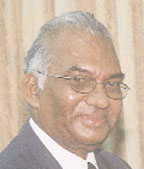
Doodnauth SinghTCL/TGI are asking that their matter, in which they are claiming losses due to the Guyana government’s unilateral waiver of a 15% Common External Tariff (CET) on cement imports, be dealt with in accordance with Article 222 of the Revised Treaty of Chaguaramas and Part 10 of the Caribbean Court of Justice (Original Jurisdiction) Rules of 2006. It is the first time that the regional court has been approached in its original jurisdiction.

In their application TCL and TGI said that under Article 82 of the Revised Treaty they are entitled to protection under the Common External Tariff (CET). Their written submission said they “have been prejudiced in the enjoyment” of their rights by the government.

They also said that T&T as the contracting party was entitled to espouse TCL’s claim but had not done so and the same was the case in relation to Guyana and TGI. Appended to the application was a letter by TCL to the T&T Attorney General Bridgid Anissette-George, dated February 20, 2008, asking for permission for TCL to pursue the claim on its own behalf or for Port of Spain to forward the claim on its behalf. Anissette-George replied on March 4, 2008 with a three-line letter that said the matter had been duly noted.

In his summary, Denbow said that it was important to note that the issue of public importance was the preservation of the integrity of the Revised Treaty and the TCL was acting in a fashion wholly consistent with the Revised Treaty. He noted that TCL was engaged in substantial cross-border investment, investing over US$10 million in a state-of-the art facility in Guyana on the condition that it would enjoy market access, have the opportunity to expand, produce and supply its products to the Guyana market. The US$10 million investment was part of an overall loan package of US$105 million obtained from the International Finance Corporation in Washington DC to expand and modernize TCL plants in Jamaica, Trinidad and Tobago and Guyana.

He said that the company’s expectation was not made possible because of the steadfast refusal of the Guyana government to implement the CET. After the further suspension of the CET from 2004 to 2006, TCL and TGI approached the government but after not getting any results in 2007 they approached the Caricom Council for Trade and Economic Development (COTED) in November 2007 which suggested that Guyana should once again implement the CET because the supply issue which the country had raised in the past no longer existed. Denbow said that there was total silence on the part of the government and the CET remained in place.

Community law“On what legal authority, one does not know,” he said adding that, “What you have here is a flagrant breach of community law.” In the circumstances, he submitted that as guardians of the Revised Treaty the CCJ ought to intervene to uphold the community law. “That is why I am asking the court to grant special leave to prosecute these proceedings,” he said, noting that correspondence between TCL and TGI to resolve the matter between ministers of the Guyana government and his clients were repeatedly ignored.

He said that the case cries out for the CCJ to intervene in order to protect the integration process of Caricom and to uphold the law between the state and investors under the Caricom agreement.

In defence of the Guyana Government, Attorney General Singh said that Denbow did not define who in terms of nationals was entitled to be heard by the CCJ and the circumstances. No where in his arguments did he establish the issue of management and control but instead referred to the history of the company and its shareholders of which Sierra Trading 9 Cemex SA de CV) held 20% of the shares, the largest in the company.

He said it was significant that when a contracting party alleges a violation between a contracting party and another it was obligatory that they enter into consultations and attempt to arrive at amicable settlement within the provisions of the Revised Treaty and further to take steps to arbitrate in disputes but this was not done.

The absence of consultation and arbitration, he said, were reasons why special leave should not be granted, adding that litigation should be a last resort.
Even though Guyana acted unilaterally in waiving the CET, he said, TCL never objected to the waivers. While the government ought to have imposed the CET, he said that it would appear that because of the difficulty being experienced the GOG implemented the policy on a yearly basis. It was because TCL appreciated their inability to meet the demand that the T&T government never implemented the CET as well, he contended.

With Justices Desiree Bernard and Adrian Saunders noting that there were breaches by the Guyana government and asking why he was using the breaches in his arguments, he explained that it was to show that in spite of them TCL allowed the violations to continue for a year because they could not supply the market.

Vienna Convention
Justice Saunders reminded him that Guyana ratified the Vienna Convention of the Law Treaty on September 5, 2005 which says that “treaties must be fulfilled in the utmost…”Justice Bernard said that whether TCL allowed the violations, the point was that the State of Guyana flouted the treaty obligations and to try to make excuses for an apparent disregard on the basis of TCL or action or inaction was inexcusable.

However, Singh replied that he was not seeking to justify but to rationalise why TCL did not take steps earlier to correct the issue of the CET. “They came late in the day,” he said.
Accepting what was said that the Guyana government should have approached COTED to get the permission to have the waiver implemented, he insisted that he was “attempting to demonstrate that in the interest of justice and for the exercise of its discretion that those factors could be taken into account to determine whether the overall requirements of justice could be utilised in such a way that leave ought not to be granted.”

In closing his arguments, he said that based on a publication he read from, dated May 2, 2008 TCL’s profits should be noted by the courts.TCL and TGI filed their request for special leave on April 3, under Article 211 (d) and 222 of the Revised Treaty of Chaguaramas, which established the Caribbean Community, including the Caricom Single Market and Economy (CSME) and Articles XII (d) and XXIV of the agreement establishing the CCJ.

Once the CCJ hears the case TCL (the parent company) and TGI would be claiming according to the written submissions “compensation from and/or injunctive relief against the Government of Guyana in respect of breach of provisions of the Revised Treaty under which Guyana is obligated to impose and maintain a Common External Tariff on cement imported into Guyana from countries outside the Caribbean Community.”

TCL and TGI are asking the CCJ to declare that the Republic of Guyana, a party to the revised treaty, violated the provisions of Article 82 by failing to implement and maintain the CET of 15% in respect of imports of building cement. They also seek a declaration that as a party to the revised treaty and member state of Caricom, Guyana failed to maintain the CET, violating the right and entitlement of the claimants to the protection of the provisions of the revised treaty.
As a consequence, the claimants feel, Guyana is liable to pay compensation to them for any loss suffered by reason of its conduct. It is also asking the CCJ for an order to direct the government to bring its regime of imports of building cement in conformity with Article 82 of the revised treaty by implementing the CET; and for damages for loss of profits as a direct result of the government’s failure to implement the CET for the period January 2007 to December 2007 and continuing; exemplary damages; an order that the costs of the proceedings be borne by the government of Guyana; as well as such other orders that the CCJ deems fit.

According to the full statement of facts, the first claimant TCL is a limited liability company incorporated under the Companies Ordinance, Chapter 31:01 of the laws of Trinidad and Tobago but it is also registered “as an external company under the Companies Act, No 29 of 1991 of the Laws of Guyana with its registered office at 2-9 Lombard Street, GNIC Compound, George-town, Guyana.

The second claimant, TGI, is a limited liability company, which was incorporated on March 17, 2004 under the Companies Act, No 29, with registered office at Lombard Street as well. TCL holds 80% of the issued capital of TGI and the other 20% is held equally by Toolsie Persaud Ltd and Anral Shipping Ltd.

July 07, 2008

Hang Together or Hang Separately

We must Hang Together - or Separately
Social Commentary
Source: The Democrat Newspaper - St Kitts & Nevis
July 7, 2008

We blindly repeat the quotes “Unity is Strength”, and “United we stand, divided we fall” but it is never clear that we really believe them enough to walk the walk despite how .often we talk the talk.

By the time this article is printed, the CARICOM SUMMIT would have ended and we hope that apart from the eloquent ‘lippy lippy’ we hear speakers giving there, that we will see action plans being implemented quickly to unify and strengthen this organization in order to combat the common problems which could ‘hang’ each island separately.

Why does TEAMWORK seem to be a dying art – both on the local and regional levels? Is it that we are so insecure that ego-bloating and insular sovereignty must be pushed ahead of long term security to boost and maintain our stranglehold on power. The bottom line is that politicians who cannot practice the tenets of UNITY at home cannot be expected to understand it on a regional level either.

This why just two weeks ago Prime Minister Gonsalves of St. Vincent and the Grenadines could see nothing wrong in creating more division in CARICOM by openly calling it a “ramshackle political apparatus”.

"It is most doubtful that we would see in CARICOM an integrated judiciary as in the OECS, or an enhanced institutionalised ''supranationality'' in political decision-making which is required to transform a ramshackle political-administrative apparatus in CARICOM into a purposive, matching vehicle correspondingly, for the Single Economy venture . . . ." Gonsalves said.


This will not mend fences or promote the spirit of working together to solve common challenges in the region. In the same way, some prime ministers see nothing wrong in invading the internal boundaries of a neighbouring state to campaign on behalf of another prime minister and call the opposition leaders insulting names.

This “I can do as I like’ attitude creeps right into CARICOM decision making. So Caribbean leaders still cannot “hang together” on matters like “Cruise Passenger taxing”, “LIAT financing”, “the Caribbean Court of Justice”, and the “One-China Policy”. They drag their feet on CSME, do not agree on adopting CAPE exams (Dominica), and opt out of whaling agreements. Even at this Summit this week, there is talk that Guyana will not sign on to the EPA agreement and that Tourism ministers are finding it hard to see beyond their own white sand beaches.

And while they will seek to create a single economic space in CSME, they will not even come close to adopting the common OECS currency which has proven to be stronger and more stable than other regional currencies (with the possible exception of Barbados)

So whither CARICOM? What exactly are we clinging to? How exactly is Secretary-General Carrington to forge unity among these “own way” sovereign states?

Caribbean scholar and recent Head of ACS, Professor Norman Girvan, said recently, "Our Community leaders are still clinging to an insular sovereignty that perpetuates failure to strengthen the region''s integration movement by an effective system of governance.”

DUMP IT, DISCUSS IT, DELEGATE IT’

If we cannot unite for the good of our country or region, what are the alternatives? Surely we cannot dump our problems, for this would be like taking on a suicidal attitude. CARICOM is great at discussing and delegating and the latter is based on the premise that each country can take on a manageable slice of problem solving. Internally, when governments fail to join with Opposition on finding solutions ESPECIALLY ON CRIME, they can at least delegate areas to civic-minded groups. Such an act can only redound to the benefit of all. Just recently a regional police officer was speaking of the areas in which action needs to be taken simultaneously for the elimination of gangs. They are:
PREVENTION – keeping children out
INTERVENTION – stopping it; providing alternatives
SUPPRESSION – more patrols; searches; law enforcement
RE-ENTRY – rehabilitation of offenders into society


Finally, since the murder of the Head of the Jamaica Urban Transit Company (JUTC), Douglas Chambers in late June, one outraged writer to the Jamaica Gleaner Newspaper has offered suggestions to the Prime Minister. We would do well to listen to all suggestions to break the circle of this escalation of crime that threatens to engulf us. Here are his suggestions:

ENOUGH! Prime Minister, Opposition leader, Security minister, Opposition spokesman on Security, Commissioner of Police and Army Chief, draw the line on the platitudes after each murder and come on TV, radio and in the printed press and speak openly and loudly in one voice. ENOUGH!

Prime minister, you need to do a number of unprecedented things NOW.

1. Speak to the nation with the aforementioned persons around you. Use the creativity shown by advertising firms during elections to have a clear, powerful message made and have the TV stations rebroadcast this at their expense in the national interest every day with the same frequency and intensity when the election messages were bombarding us.
2. Co-opt the DJs sound system owners, discos to create voice-overs with strong, powerful street messages played at every session as a rule.
3. Order radio stations to stop playing all gun-related garbage now and anyone promoting ''informer fe dead'' must be treated as a criminal and charged for inciting murder.
4. Invite churches, service clubs, schools, businesses to dedicate a half day per month to do community service work to spread the message.
ENOUGH!


We need to ‘hang together’ as a country and as a region, or we shall ‘hang separately’.

June 30, 2008

CARICOM'S CONFLICTING SIGNALS

Caricom's conflicting signals
RICKY SINGH
Source: Jamaica Observer
Sunday, June 29, 2008

LATEST INDICATION of significant differences among member governments of the Caribbean Community (Caricom) has come from Guyana on the eve of this week's 29th Caricom Summit that gets underway on Tuesday (July 1) in St John's, Antigua.

It was the disclosure last Wednesday in Georgetown by President Bharrat Jagdeo that, based on further information and legal advice obtained, the Guyana Government may not join Community partners in signing next month the Economic Partnership Agreement (EPA) that was initialled last December in Barbados between representatives of the European Commission (EU) and CARIFORUM (Caricom plus Dominican Republic).

Prior to this development, and amid conflicting signals on moving the process forward to access the Caribbean Court of Justice (CCJ) as the final appellate institution for Community partners, there was the recent verbal blast by Vincentian Prime Minister Ralph Gonsalves over "political decision-making" in Caricom and his scathing dismissal of the Community Secretariat's functioning as "a ramshackle political-administrative apparatus..."

It is likely that Secretary General Edwin Carrington may allude in his remarks at the opening session, to Gonsalves' criticisms that were made on June 16 when he addressed the launch of public consultations on the draft OECS Economic Union Treaty.

The Vincentian leader, who will be briefing his Community colleagues on an alleged plot involving drug dealers to assassinate him, had said that he was "satisfied that the politics of a limited regional engagement in Jamaica shackled by the ghosts from the federal referendum; the politics of ethnicity in Trinidad and Tobago and Guyana; a mistaken sense of 'uniqueness, specialness and separation' among large sections of the Barbadian populace; the peculiar distinctiveness of Haiti and Suriname, and the cultivated aloofness from the regional enterprise by The Bahamas, are destined in the foreseeable future to keep Caricom as a 'Community of sovereign states' in which several of its member states jealously guard a vaunted and pristine sovereignty...." Conflicting policies and attitudes towards advancing the process of free movement of Caricom nationals; differences over foreign policy issues as well as in approaches for attracting foreign investment and economic aid have also been causing concerns in more recent times among member governments and other stakeholders.

Those Caricom leaders who last week participated in the New York Conference on the Caribbean are reported to have been exposed to a common thread in the thinking of US lawmakers and financial investors in favour of dealing with Caricom as a common entity and not with fragmentation on the edges in terms of less or more developed member states.

So far as embracing the new trade and economic package with the 25-member European Union is concerned, even prior to the conclusion negotiations for a full EPA, Guyana's president had expressed strong reservations in contrast to a very favourable response from Jamaica's Prime Minister Bruce Golding, who shoulders lead responsibility for the Community's Prime Ministerial Sub-committee on External Economic Negotiations.

Among suggestions surfacing for discussion on signing arrangement for the EPA is that it be put on hold and for initiatives to be pursued instead for a special summit of the 78-member African Caribbean and Pacific (ACP) to, hopefully, arrive at some common positions on core aspects of the regional accords before any meeting with EU representatives for a signing ceremony which Barbados has already agreed to host.

Both Jagdeo and Golding are scheduled to be among five heads of government to address Tuesday evening's ceremonial opening of the four-day summit. This has aroused new interest about the tone and content of their planned messages to the people of the 15-member Community.

For Golding, who became prime minister following last September's general election at which his Jamaica Labour Party secured a 32-28 parliamentary victory, it will be his debut address to a Caricom heads of government conference.
REGIONAL DEVELOPMENT FUND
He would be expected to also signal his administration's position in relation to Caricom's Regional Development Fund (RDF) which is scheduled to be officially launched during this week's summit.
Status of allocated contributions by member states to enable operationalising of the RDF is viewed as essential to its formal launching. With the exception of St Lucia which has almost completed its fixed initial allocation, the OECS countries are either far below or like Grenada and summit host Antigua and Barbuda, are still to come forward with their contributions. In contrast, Barbados has already paid up US$5 (five) million of its allotted share of US$11 million.

Creation of the estimated US$250-million fund, for which Trinidad and Tobago will be the single largest contributor among Caricom with an overall pledge of approximately US$120 million, and has already fully paid up its initial contribution of US$37 million was strongly advocated by the Organisation of Eastern Caribbean States (OECS) as a mechanism to provide special and differential treatment for enhancing socio-economic development for the less-developed countries.

The rest of Caricom responded by turning to the Caribbean Development Bank (CDB) for expert guidance in creation of the RDF with the understanding that the countries of the OECS in particular will be on board by mid-2007 for the Community's single market as other partner states had done in January last year and with all working together for the realisation of a single economy by 2015.

Should member states fail to honour pledged commitments they could jeopardise the prospects of the fund attracting resources from foreign donor nations and international financial institutions. A major provision for accessing the fund is the denial of resources to defaulting contributors.

After a series of postponements, launching of the RDF would be a positive development in the face of lingering uncertainties about the way forward for Caricom - the regional economic integration movement that was inaugurated five years after the birth of the Caribbean Free Trade Association (CARIFTA) in 1968 (not 1965 as incorrectly appeared in an earlier article).

June 17, 2008

Independence and Accountability

Caribbean Chief Justices underscore independence, accountability
Monday, June 16 2008 @ 05:00 PM

Source: Breaking News ( Trinidad and Tobago)
http://news.bn.gs/

The 9th Meeting of the Caribbean Heads of Judiciary, June 5-6, 2008 today dispatched the following communiqué to the media.
OPENING CEREMONY
The opening ceremony took place in the Regency Ballroom of the Hyatt Regency Trinidad, on the morning of June 5, 2008, with a keynote address from the Honorable Chief Justice and President of the Constitutional Court of South Africa, Mr. Justice Pius Langa on the topic, The Judiciary: Maintaining Trust and Confidence.
The topic of Mr. Justice Langa’s address was also the theme agreed upon for the Ninth Meeting of the Heads. Among those attending the opening ceremony were: His Excellency the Acting President of the Republic of Trinidad and Tobago, Mr. Danny Montano; the Speaker of the House of Representatives of Trinidad and Tobago, the Honorable Barry Sinanan; former President of the Republic of Trinidad and Tobago, Mr. A.N.R. Robinson; former Chief Justice of Trinidad and Tobago, Mr. Satnarine Sharma, Judges of the Supreme Court of Trinidad and Tobago and the Caribbean Court of Justice, other Judicial Officers, members of the diplomatic corps; senior State officials, and representatives of the private sector and other distinguished guests.The ceremony was also witnessed and covered by a wide cross section of the Trinidad and Tobago media, and disseminated live to the national community by television.
AGENDA
The Agenda for the Conference was disposed of in three plenary sessions over the two scheduled days, including a working lunch hosted by The Honorable the Chief Justice of Trinidad and Tobago, Mr. Justice Ivor Archie.
Agenda items included the following:
• Matters arising out of the 8th Annual Conference Judicial Independence and Administration including presentations by Court Consultant, Mr. Robert Hann, and Court Executive Administrator of the Caribbean Court of Justice, Mrs. Christie-Ann- Morris-Alleyne on the topic: Context and issues of Court Administration; Alternative Models of Court Administration and recommendations for the way forward.
• Publication of the Commonwealth Caribbean Civil Court Practice Text;
• Update on Conference of Judicial Officers;
Update on Caribbean Court of Justice Trust;
• Discipline and Accountability of Judges, (including a presentation by the President of the Caribbean Court of Justice, the Right Honorable Michael de la Bastide).
AGREEMENTS
Heads devoted much of their attention to discussion of the principles of judicial independence and accountability.
Heads noted that the principle of judicial independence in the 21st Century embodies much more than non-interference in the adjudicative function. It also includes the provision of adequate financial and administrative resources placed under the control of the Judiciary to facilitate proper discharge of judicial responsibilities.
Heads recognized that in this region and internationally, the expanded boundaries of judicial independence now involved the management by Judges of many of the processes necessary for the effective and efficient delivery of justice.Heads reaffirmed their commitment to impartiality in the exercise of the judicial function and stressed that members of civil society must at all times be able to perceive the Judiciary as impartial and independent of the legislative and executive branches of government.
Heads agreed also that judicial independence and judicial accountability must co-exist, and the Judiciary has an inescapable duty to account to the public for the performance of its functions. Judiciaries are obligated, not only to hold themselves responsible for their own conduct and performance, but must also do so in a manner that is fully transparent.
Heads accepted that in order to maintain confidence in the administration of justice, the Judiciary is under an obligation to inform the public about its work and function.Heads agreed that Judges’ allowances and salaries should be fixed by independent Salaries Review Commissions.
Heads also agreed to make representation to Regional Governments to ensure that all Judges and other Judicial Officers, including Magistrates, are provided with adequate security in recognition of the risk inherent in the performance of their duties.Heads noted that Judiciaries were taking positive steps to implement programmes of continuing judicial education and training. They regarded this as being essential for enhancing the performance of Judges and Judicial Officers.
Heads urged that the planning and financing of such training should be under the control of the Judiciary in keeping with the Latimer House Principles, agreed to by the Commonwealth Heads of Government. Heads further noted that prior approval of the Executive ought not to be required for Judges and Judicial Officers to participate locally and abroad in continuing education and training.
The Conference agreed as follows:
• Any disciplinary process for Judges should be insulated from political interference from inception to conclusion
• Procedures should be established for receiving and dealing appropriately with complaints against Judges, Magistrates and other persons performing a judicial function. The public should be informed of the prescribed procedures.
• Appropriate mechanisms should be put in place to deal with judicial behaviour that falls short of the kind of misconduct that would justify removal from office.
• Appropriate standards of ethical conduct for Judicial Officers should be adopted by all Judiciaries of the Caribbean and such guidelines should be published and made available to all members of the Judiciary and to members of the public.
On matters pertaining to Judicial Independence as it relates to administration, alternative models and the way forward, the Conference agreed as follows:
• That Judiciaries establish properly resourced offices of Court Administration, under the direct control of the Judiciary, with responsibility for all matters relevant to court administration.
Matters to be under the direction of Court Administration should include:
a) Finance and budgeting,
b) Human Resource Management (recruitment, training, terms and conditions, and discipline)
c) Executives should work towards providing the minimum percentage of the national budget for annual allocation to Judiciaries that is consistent with international benchmarks.In accordance with decisions at the Eight Annual Meeting of Caribbean Heads of Judiciary, the Constitution has been amended so as to provide for the President of the Caribbean Court of Justice to be a member of the Conference.
The Honorable Chief Justice of Belize, Mr. Justice Conteh, has agreed to represent the Conference as a member of the Board of the CCJ Trust for one more year.The Heads also agreed that a meeting of Judicial Officers of the Region be held in late June or early July 2009.Chairmanship of the next Conference is expected to be held by the Chancellor and Head of Judiciary of Guyana

June 11, 2008

Tempests Rage: Yet We Linger

Tempests rage: yet we linger
Published on: 6/11/08.
Source: The Nation Newspaper

If you tickle us, do we not laugh?
-The Merchant of Venice Act III, Scene 1.

MOST CARICOM LEADERS and citizens accept there is value in regional collaboration. That in the present sea of economic turbulence, driven by unyielding energy costs and surging food prices, the region's salvation must come from one voice resonating to a chorus that we are one people. Yet, these sentiments are mere words without serious intent or meaning.

All know that our small size and fragile economies stymie sustainable development. That our separate voices are too weak to be heard far less understood; that our countries have been known to be looked upon as 'a beautiful piece of real estate' where playboys languish on the sands and in the sun, while partaking of the libation of their choice.

It is years now since the 3B's – Barrow, Bird and Burnham – spawned CARIFTA. There has been a change in nomenclature – from CARIFTA to CARICOM – yet we still search for harmonisation of fiscal incentives; a regional Central Bank; a single currency; an all-embracing Caribbean Court of Justice; common cross-border legislation relating to a stock exchange; freedom of movement for CARICOM citizens; common customs tariffs; regional air and sea transport and regional security. Yes, we continue to be long on talk and short on action.

Here at home, as if blinded by regional practice and example, we have spent some two decades fiddling with the control and arrest of PSV culture and disrespect for law and order. That the minds of our young students, hungry for learning, are being vicariously poisoned by dancehall fare unsuitable for junkies seems not to be a sufficient bother.

Our sidewalks, store pavements and even streets are belching with the encroachment, even invasion of vendors claiming the right of the small man "to make an honest dollar". Worse still, PSV commuters as well as bystanders are being deafened by noise way beyond legal limits, claiming to be today's music and a pleasure to warped sensibilities.

Amidst price rises, creeping inflation and serious challenges in providing housing stock to satisfy demand we have permitted an unmanaged immigration process, bringing with it additional pressure for school places, jobs, and a real potential for social dislocation, crime, and health issues.

We seem to see no compelling reason to stop the rot despite the growing and frightening recklessness of violent crime in neighbouring Trinidad and Tobago and Jamaica – a natural sequel to open migration, attracting, as it often does, scores of unskilled people. Meanwhile, the region smiles at the new title of being among the leading murder capitals worldwide.

We seem to find more energy and tasty satisfaction in debating the wisdom of a realignment of the age of consent, majority and its related consequences. Although our water stocks are known to be finite, our inability to provide natural gas to households in need is glaring, our productivity levels are showing decline, discordant voices continue to bellow unashamedly in the highest forums of the world, seemingly expecting a magical outcome of benefit to self and region.

June 09, 2008

AG of Antigua Endorses CCJ


Simon endorses CCJ as final court of appeal
Monday June 09 2008
by Patricia Campbell
Source: Antigua Sun

Attorney-General Justin Simon has again made a case for the Caribbean Court of Justice (CCJ) to replace the British Privy council as the court of final appeal, saying that sufficient safeguards have been put in place to protect against political interference.

He said that the main concerns have been addressed in the agreement which established the CCJ, and argued that the region is also developing politically and evolving away from the restrictive thinking that would stimulate such interference.

Simon however acknowledging that continued apprehension that the CCJ could find itself subject to political pressure and influence are not unfounded.


“The concern is legitimate, understandable and, in a lot of quarters, genuine,” he said, responding to query on the matter.

“Let us take our own experience here in Antigua and Barbuda. A number of pieces of legislation which were passed here in Antigua and Barbuda were overturned by the Privy Council.

"It took the system to go right up to the top for the laws to be struck down as unconstitutional.

“Our history shows that our High Court, which was the first court which dealt with those various matters, ruled (them) unconstitutional, but the Court of Appeal overturned and it took the Privy Council to reverse the decision of the Court of Appeal and reinstate the decision of our High Court.”

He cited the Tim Hector case which challenged legislation that the truth was not a defence to libel and a number of other cases where the value of the Privy Council was proved. Nevertheless, said Simon, “There are a number of areas which have been addressed in respect of the CCJ which would, to my mind, have removed that sort of political overshadowing in respect of that court.”

He pointed out that a trust fund has been established at the Caribbean Development Bank for financing the operation of the CCJ, so that its expenses are not part of the budgetary estimates of governments.

This means that governments cannot withhold or withdraw funds as a means of manipulating the decisions of the court.

Ain addition to this, the attorney general pointed out that judges are appointed by a regional legal and judicial commission, with representatives from various civil institutions.

“Only the appointment of the president must meet the approval of the heads of governments and only a majority of the heads (is needed). With us here in the OECS Court, the chief justice has to meet with the approval of all of the OECS prime ministers.

"For that very reason, Justice Byron remained acting as chief justice for a good five years before he was appointed.

"Justice Alleyne, who has just left the court, was appointed acting chief justice and remained acting for two years because we could not get the unanimous approval,” he said.

Simon was making a case for judicial independence during last week’s Conference for Academic Research and Development, organised by the Antigua State College.

June 05, 2008

Caribbean Court of Justice: Are we ready yet?
Godfrey Smith
Date of Publication: April 3, 2007
Posted by: Godfrey Smith
Tuesday, April 03, 2007

In an interview in May 1999 Lord Browne-Wilkinson, the then President of the Privy Council, intimated that appeals to that Court from the Caribbean should end. He urged the Caribbean to establish its own final court on the ground that the ultimate court of appellate jurisdiction of a state, should be in the state, staffed by citizens of that state and not by outsiders.

Persistent prevarication
The Caribbean Court of Justice (CCJ) was inaugurated on April 16th 2005. The historic first sitting of the CCJ took place on 8th August 2005 at the Court’s offices in Port of Spain, Trinidad and Tobago. The sitting was to consider an application for special leave by a Barbadian company to appeal from a decision of the Barbados Court of Appeal. Since then about five cases have been brought before the CCJ, three more from Barbados and two from the Cooperative Republic of Guyana. The court is now firmly established and fully operational for those Caricom member states that have subscribed to it. As the second anniversary of the inauguration of the CCJ approaches, it is perhaps timely to review where we are with the CCJ and to ask: is Belize now ready to fully sign on?
The idea for the setting up of a Caribbean court to replace the Judicial Committee of the Privy Council (Privy Council) in England was first seriously raised at a Caricom Heads of Government meeting in Kingston, Jamaica in 1970.
More than thirty years later, on February 14th 2001, ten Caricom countries finally signed unto the Agreement in Barbados, establishing the Caribbean Court of Justice: Antigua and Barbuda, Barbados, Belize, Grenada, Guyana, Jamaica, St. Kitts and Nevis, St Lucia, The Republic of Suriname and the Republic of Trinidad and Tobago.
The passionate debate in Caribbean countries that preceded the signing of the Agreement is rivaled only by the persistent prevarication by some countries over how tightly – if at all- the CCJ should be embraced.

Belize & the CCJ
In Belize, the government attempted to fully embrace the CCJ. The CCJ has two distinct aspects. The first is called the original jurisdiction. This refers to the court’s power to deal fully with all trade disputes and trade-related issues that might arise between two or more member states of Caricom. This is considered to be a sine qua non for the successful operation of the Caribbean Single Market and Economy (CSME).
The second is called the appellate jurisdiction. This refers to the court’s power to fully and finally determine appeals from decisions of Courts of Appeal in the Caribbean. In this regard, the CCJ was in conflict with the British Privy Council which, under the national constitutions of the majority of Commonwealth Caribbean countries, was the court empowered to dispose of appeals from Courts of Appeal throughout the region.
For Belize to replace the Privy Council with the CCJ required a constitutional amendment supported by no less than three-quarters of the members of the House of Representatives. The ruling PUP had lost its three-quarter majority shortly after its general election victory in 2003 with the untimely death of its Cayo South representative, Mr. Agripino Cawich.
The government was able to pass legislation introducing the CCJ in its original jurisdiction because this required only a simple majority. But the Opposition blocked the legislation abolishing the Privy Council and introducing the CCJ as the final court of appeal for all criminal and civil matters. The Opposition copycatted the Trinidad & Tobago Opposition by withholding support for the legislation unless the government agreed to certain “political reform” proposals and financial support for Opposition constituencies. The government refused and the legislation floundered.

Retain the relic
The case against replacing the Judicial Committee of the Privy Council with the CCJ has four essential arguments. First, that judges of the CCJ will not be as insulated from political interference and may therefore not enjoy the Olympian aloofness of their British counterparts in the Privy Council. Second, that financial resources which are vital for the permanence and continuity of a CCJ are scarce and may not be forthcoming from undisciplined and profligate Caribbean governments. Third, that the money would be better spent improving magistrates courts which deal with 80% of cases in Caribbean countries. Fourth, that retaining the Privy Council as the final court of appeal is more attractive to foreign investors and costs less since it is paid for by the British.

A question of sovereignty
Ranged on the other side of the debate are also four basic arguments. First, that a CCJ is more consistent with our status as independent, sovereign states. Why should we be self-governing in all aspects but yet have a foreign court as our final court of appeal? Second, that the CCJ is more conducive to the development of a regional jurisprudence that is sensitive to the history, culture and ethos of Caribbean people. Third, that in relation to foreign investors, the majority of Caribbean cases going up to the Privy Council are criminal cases and only a handful are civil cases. Fourth, that the Privy Council is far removed from the Caribbean both geographically and in its appreciation of local circumstances.

Competence, independence, permanence
With two years having passed since its inauguration, the court is manned by competent judges some of whom held the highest judicial offices in their respective countries. These judges of the CCJ enjoy security of tenure and hold office until they attain the age of seventy-two years and can only be removed for inability to perform the functions of office or for misbehaviour.
They were appointed by an independent Regional Judicial and Legal Services Commission comprised of representatives from the Organization of the Commonwealth Caribbean Bar Association and the Organization of the Eastern Caribbean States Bar Association, a rotating Chairman of the Judicial and Legal Services of a member country, a rotating Chairman of a Public Service Commission of a member country, two persons from civil society nominated jointly by Secretary-General of Caricom and the Director-General of the OECS, two distinguished jurists nominated jointly by a Dean of one of the Faculties of Law and the Chairman of the Council of Legal Education, and two persons nominated jointly by the Bar or Law Associations of the member states.
Caricom governments have contributed to a US $100 million trust fund the interest of which fund the operations of the CCJ. There is therefore no need for the court to go cap in hand to politicians for its upkeep, thereby opening it to the possibility of political interference.

While we have been intently focusing on the comparative advantages of the CCJ through the prism of the Privy Council for several decades now, we may well have missed an important if embarrassing point. In an interview that was published in the May 1999 issue of The Lawyer, Lord Browne-Wilkinson, the then President of the Privy Council, intimated that appeals to that Court from the Caribbean should end. Browne-Wilkinson complained that appeals related to death row prisoners in the Caribbean had created a burden on the time and resources of that Court. He urged the Caribbean to establish its own final court on the ground that the ultimate court of appellate jurisdiction of a state, which has to make important policy decisions on legal principles, should be in the state, staffed by citizens of that state and not by outsiders.
Yet, in Belize, during the debate on the Bill to abolish the Privy Council, Her Majesty’s Loyal Opposition shamelessly hung onto the coattails of the Privy Council and questioned the brainpower of Caribbean judges vis-à-vis their British counterparts. It’s time for the government to reintroduce the Bill and flush out the Opposition on this crucial issue of sovereignty and regional identity. Belize should abolish the Privy Council and bring on the CCJ.

Owen Arthur calls for support of CCJ

Colonial attitude to CCJ
Source: radiojamaica.com - Jamaica
June 4, 2008

Former Barbadian Prime Minister Owen Arthur said greater power must be given to CARICOM institutions to allow them to implement decisions made at the regional level. Mr. Arthur, now an opposition Member of Parliament said the failure of all but two CARICOM countries to identify fully with the Caribbean Court of Justice is a symbol of a continuing colonial attitude.
He was speaking recently in Trinidad and Tobago at the launch of a new forum on policy and leadership.
Freed of the responsibility of holding Prime Ministerial office, Mr. Arthur said the region must not be timid in taking political and economic decisions. He said there is a new world of international trade which requires reciprocity.
Mr. Arthur said the old, one way free trade arrangement has vanished around the bend in the river.

June 02, 2008

Public Opinion

The single market and economy needs to be promoted among ordinary people in a more practical way
Source: Stabroek News - Letters
June 2, 2008

Dear Editor,
It is unfortunate that at this juncture of our history as a Caribbean region, a sister country would callously disrespect the citizens of another sister country. I refer to the incident where some twelve Guyanese were refused entry by the Trinidad immigration authorities last week. This unwelcome act comes at a most inappropriate time when Guyana is slated to host Carifesta X, to which I am positive Trinidad, like other Caribbean countries, hopes to send its contingent.
This is also a time when great emphasis is placed on the Caribbean Single Market and Economy (CSME), which seeks to encourage the free movement of skills throughout the region; a time when the Caribbean Court of Justice has emerged as the final court of appeal for certain member states; a time when foreign affairs ministries are issuing Caricom Skilled Certificates to their citizens in order that skills are easily transferred or exchanged within the region, thereby aiding in the efforts to collectively tackle some of the new and emerging challenges of globalization.
The actions of the Trinidadian immigration authorities, clearly, do not augur well for this spirit of ‘oneness’ which we in the Caribbean have been dying to achieve since the signing of the Treaty of Chaguaramas in 1973.
It is regrettable that while Caricom as well as governments within the region continue to promote policies aimed at fostering greater cohesion, unity, economic co-operation, etc, not much work is being done at the local level to ensure that the people subscribe to the ideals which will help to achieve the objectives of those policies. From what transpired at the Piarco Airport, it is obvious that there is a big disconnect between the immigration officers, junior level government employees, and the Manning cabinet. Imagine what might be the extent of the disconnect between the people at the grassroots level and the cabinet? This disconnect might not be a situation peculiar to Trinidad but might very well be a common thread that runs through countries of the region.

Guyanese have been experiencing this kind of unwelcoming treatment from various countries of the region, in particular Barbados, but it was hoped that with all these new initiatives by Caricom that the situation would have changed. However, it now seems that might not be the case. It is therefore fitting that Caribbean governments and the Caricom Secretariat take on a more proactive role in meeting the ordinary people in the community to aggressively promote the single market and economy concept in a practical way. Special training should be given regularly to immigration officers and airport workers to sensitize them to the critical role they have to play in this process, since in most instances they are the first to have contact with these new workers or migrants.
I hope that Caricom, through its secretariat, does not allow this matter to fester, but that it will take urgent measures to ensure that the Guyana government and the Trinidad government settle this matter.

Yours faithfully,
Lurlene Nestor

May 11, 2008

Privy Council/ CCJ

The Reporter Sunday, 11 May 2008
Harry Lawrence - Publisher

A British court in London ruled this week that it has jurisdiction to decide disputes between the Government of Belize and the Belize Bank Limited. In doing so, the court simply ignored the jurisdiction of the Supreme Court of Belize.

The British court claimed jurisdiction on the strength of an agreement signed between the Prime Minister of Belize, Mr. Said Musa, and the Belize Bank. The agreement stipulates that any dispute between the government and the Belize Bank would be determined not by a Belize court but by a British court.

This is only one of several bizarre arrangements which Mr. Musa made while he was Prime Minister of Belize. He signed another agreement stipulating that Belize Telecommunications Limited, the monopoly utility company now under Mr. Ashcroft’s control, is to be allowed to make a profit of 15 percent on its operations, and that the Government of Belize would make up the short-fall when profits fell below 15 percent.

He also signed an agreement guaranteeing government secrecy about this and other agreements he had signed.

These secret arrangements have allowed a few favoured companies to exploit consumers in Belize by making immoral profits. They are also being used now to frustrate the legitimate resolve of the new government and limit the jurisdiction of the Supreme Court.

Any arrangement by any Prime Minister to limit or in any way circumscribe the jurisdiction of the Supreme Court in Belize is unconstitutional and ought to be resolutely resisted. The Prime Minister has no authority to do anything which would have this result.

The Prime Minister’s office combines administrative and executive and legislative powers but he had no authority over the judiciary and no powers to limit the jurisdiction of the Supreme Court.
We believe that the arrangement to keep certain agreements secret and hidden from public view is a corrupt practice which will have the most serious consequences. The practice of guaranteeing certain favoured companies a minimum profit of 15 percent on their operations is also a corrupt practice - exploitative in nature and intrinsically unjust.

This is a case which should quite definitely go before the Caribbean Court of Justice and not the Privy Council because it deals with a conflict between British jurisdiction and the Belize jurisdiction.

Belize should pursue its case vigorously before the Caribbean Court of Justice and not be intimidated by the British court.

May 10, 2008

Race and CCJ

MP pulls up UNC-A over ethnic talk
Ria Taitt Political Editor
T&T Express
Saturday, May 10th 2008
The UNC-A cannot speak about ethnic balance in the panel of judges at the Caribbean Court of Justice, when its own parliamentary bench is hardly reflective of this kind of balance, Information Minister Neil Parsanlal said yesterday.

Speaking in the House of Representatives on the CCJ bill yesterday, Parsanlal stated: "Before I can take out the beam in anybody else's eye, I have to take out the mote in my own. Is the ethnic composition, because that is what they are talking about, is the ethnic composition of that bench reflective of the people of Trinidad and Tobago? I submit it is not," he said.

He said on the PNM side, there were "cocoa payol, some half-Chinese, some Indian, some African and me, the quintessential dougla".

"The PNM is reflective of the face of Trinidad and Tobago," he declared. Parsanlal also criticised the constant references by UNC-A speakers to African dictators.

"When references are made to dictators, it is always about Zimbabwe and Mugabe. All the references speak to people who look a particular way and who live in a particular place. There is absolutely no reference to any other countries where there might be dictators. MP for Mayaro (Winston Gypsy Peters), how is it that no references are made, for instance, to dictators from Pakistan?" Parsanlal waxed poetic as he quoted the "quintessential Caribbean man", Black Stalin. He said if he were an East Indian judge, he would feel insulted if he was appointed to the CCJ just because of his race. That would amount to "tokenism" and "patronage", he said.

On Ramesh Lawrence Maharaj's charge that CCJ judges had no work to do and were sipping coffee and reading papers, Parsanlal said he would not be surprised if citizens mistook that for rumshop talk.

"I want to assure the national community that no alcohol is served in the tea-room." Parsanlal also dismissed allegations that CCJ judges were being favoured, saying that some allowances given to local judges were not given to CCJ judges.

COTED or CCJ?

Taking Jamaica's case to COTED
Jamaica Gleaner Editorial
published: Friday May 9, 2008

This weekend, Caricom's Council for Trade and Economic Development (COTED), the ministerial group that oversees broad economic issues within the 15-member community, holds a regular meeting in Barbados.

However, it is unlikely that this session of COTED will be taken with the routine dispensing of issues. It could be a rather contentious gathering of ministers. And Jamaica will be at the forefront of the arguments, pursuing what it sees as a critical point of national interest: ensuring the security of food supplies.

COTED is an important forum; it is the ministers who sit in this forum who, generally, decide on any varying of Caricom's Common External Tariff (CET), that is, the rate of duty that member states apply to imports from third countries to protect regional production.

Opposition to suspension

At issue is Jamaica's application for the suspension of the 25 per cent CET on the importation of up to 34,000 tonnes of rice so as to cover what Kingston insists is a shortfall in supplies from with the community. Guyana, Caricom's major supplier of rice, opposes the suspension. According to Georgetown, its producers can meet all of Jamaica's demands.

A substantial part of the problem, it appears, is that Jamaica does not like the fact that Guyana will not commit to forward contracts beyond a month, given the global spike in commodity prices, including that for rice. So, to put it bluntly, Jamaica's trade minister, Karl Samuda, feels that with the Guyanese hoping to maximise returns from purchasers who are willing and capable of paying higher prices, Jamaica is being shafted. And rice is a staple in Jamaica, even though we do not - having a long time ago abandoned the effort - grow the stuff.

There are a number of things that must happen in Barbados, not least of which is that Guyana must come clean on the supply issue. Kingston needs to be satisfied that Georgetown is abiding by both the letter and spirit of the rules.

Single economy pretensions

This, after all, is no arbitrary trade arrangement. Caricom is a single market, with pretensions towards a single economy. In that regard, we expect Jamaica, or any other member of the community, to be subject to the same pricing terms in the purchase of rice as any Guyana buyer - except for the cost of shipping. Trying to squeeze higher prices out of Jamaican purchasers, if that is what Guyana is attempting to achieve by insisting only on short-term contracts, will not do. Jamaica has to be assured, in so far as possible, of a certainty of supply.

But by the same token, Kingston has to take on board the fact of the rise in the price of rice on the global market, and to consider this matter of food security in the broader regional context rather than a purely domestic issue. For, as Mr Samuda will be aware, we have in the past undermined domestic agriculture and weakened food security by the full embrace of cheap and subsidised imports. The revival of a Regional Food Plan, which foundered in the 1980s, is important.

But if Jamaica feels that Guyana is playing games and it gets no satisfaction at COTED, it should test Georgetown's behaviour at the Caribbean Court of Justice which, in its original jurisdiction, interprets the Caricom treaty.

May 06, 2008

China Supports CARICOM Integration

Premier Wen: China supports Caribbean integration process
Source:
www.chinaview.cn
2008-05-06

BEIJING, May 6 (Xinhua) -- Premier Wen Jiabao said on Tuesday that China supported the Caribbean integration process.

"China will strengthen dialogue with the Caribbean community based on mutual respect, reciprocity and equality to promote south-south cooperation and achieve common prosperity," said Wen.
He made the remarks during a meeting with David Thompson, prime minister of Barbados, who arrived in Beijing on Monday for a four-day official visit to China.

Wen said China and Barbados had maintained good cooperation in the areas of trade, technology, and personnel training as well as in such international organizations as the United Nations.

"Both China and Barbados are developing nations and enjoy common interests," Wen said. He vowed to expand cooperation with Barbados on trade, tourism, architecture and sustainable development.
Thompson expressed gratitude for China's support to his country's economic and social development.
He said Barbados attached importance to relations with China and would continue adherence to the one-China policy. He also said that Barbados supported the Beijing Olympic Games and China's participation in the Inter-American Development Bank.

May 04, 2008

CCJ Michael De La Bastide defends CCJ

Source: Trinidad Express
Sat, 03 May 2008 9:29 PM PDT
It is not true that the judges of the Caribbean Court of Justice have no work to do and spent their time "drinking coffee and reading papers".

President of the CCJ Michael De La Bastide, in a interview at his Henry Street, Port of Spain, office, said the court has been receiving cases from Guyana and Barbados, which have approved the CCJ in both its original and final jurisdiction.

The interview was done shortly after the debate on the CCJ bill in the House of Representatives.
De La Bastide said 14 appeals were filed in 2007 -12 from Guyana and two from Barbados. He stressed, however, that it was the experience of all newly established courts -regional, international and domestic-that it took time for the volume of cases to build. He said this was the case with Canada, when its Supreme Court was established in 1949 and that the same thing happened in New Zealand and the International Criminal Court.

"I have no doubt that as time goes out, even without the accessation of other states, the workload of the court would increase. And I have in mind, the original jurisdiction," De La Bastide stated.

Businesses were beginning to recognise that they have a possibility of getting redress for breaches of the Treaty of Chaguaramas, he said. And, he contended: "If the feeling is that the Caricom member-states are not getting full value for their money from the court, then the answer is to use it."

De la Bastide said it was unfortunate that the decision on whether to transfer appeals from the Privy Council to the CCJ had become so highly politicised. "Fundamentally it should not be a party/political view," he said.

De La Bastide said he was "flabbergasted" by a idea he heard on television (during the debate on the CCJ bill in the Parliament two weeks ago) of using the CCJ as a second appeal court, allowing for final appeals to the Privy Council.

"Is this going to be an act of kindness to litigants? To interpose yet another stage of appeal en route to the final appeal? Is the CCJ to be put on probation and depending on how accurate it can forecast the way in which each case is decided by the Privy Council ... it would then be trusted to make a final decision? he asked.

Speaking in a Jamaican dialect, he quipped that this was "bias against local in favour of foreign".
The CJ president also dismissed statements made during the same debate that the local Court of Appeal generally got it wrong because the Privy Council overturned over 50 per cent of its decision.

"It is based on an irrebuttable presumption that the Privy Council gets it right every time. Despite the great respect I have for their Lordships, that is a presumption that is totally irrational," said De La Bastide, who is himself a member of the Privy Council.

"Apart from the possibility that there may be more than one 'right solution' to a legal question, what may establish one's preference for one (solution), rather than the other, is the extent to which it would favour or be favoured by local conditions," he said.

He noted that some of the Privy Councillors had a knowledge of the handicap they operated under when determining cases for a society with which they were entirely unfamiliar.

De La Bastide, who has been a defender of judicial independence throughout his career, stressed that he remained unrepentant in this regard and pointed to the measures taken to protect judicial independence in the establishment of the CCJ.

He complimented Caricom states and the Heads of Government on the quality of the arrangements made to protect the court from political and other extraneous influence and noted that many judges of regional and international courts were "envious" of these arrangements.

"No member of the Regional Judicial Legal Service Commission owes his seat to any politician or to political connections. The president is appointed by the majority of Heads (of Government). But their choice is restricted by someone recommended by the RJLSC," he stated.

Similarly, he noted, judges can only be removed after an enquiry by a independent tribunal.

Suggesting that the CCJ judgments were of a high quality, De La Bastide said that the West Indian Law Report published by Butterworth in England, which has tended to report only Privy Council judgments, had been reporting many of the judgments of the CCJ. In Volume 69 of last year, five judgments of the CCJ have been selected for reporting, he said.

De La Bastide also said it would be nothing short of a "regional tragedy" were the CCJ not permitted to achieve its full potential.

He stressed that this potential involved the Court fulfilling its "two-fold function of supporting regional integration and of administering justice effectively and appropriately to the peoples of Caricom.

"If the opportunity which the establishment of this court has now created is thrown away, then I fear it may be a long, long time, if ever, it comes again," he said.

April 30, 2008

National vs Regional Court ( T&T)

Volney: Govt is favouring CCJ
Wednesday, April 30th 2008

Source: Trinidad & Tobago Express

THE debate over the amount of money spent behind the Caribbean Court of Justice (CCJ) entered the Hall of Justice yesterday, when Justice Herbert Volney complained about the malfunctioning public address (PA) system in the Port of Spain Second Criminal Court.

Volney said the PA system in the High Court had not been working for the past five years, but the CCJ had a system where you could hear "a pin drop".

He made the statement after the 12-member jury complained about not being able to hear the testimony of police constable Kishaa Mungroo.

Mungroo took the witness stand yesterday in the murder trial of Anthony Mc Carthy, who was fatally shot near his mother's Laventille apartment on May 16, 2006.

Two men, Ijah Oba Braithwaite and Marlon Taitt, are accused of shooting to death the 47-year-old former URP foreman, who was also a State witness in the April 2005 shooting death of his nephew, Oba Jones.

The debate over the Caribbean Court of Justice (Headquarters) Bill, 2008 originally took place in the Upper House, where the bill was passed and then at the Lower House last week. Many opposition ministers and senators critised Government for pumping millions of dollars into the court, since the judges had very little work at this stage, since the court was yet to be accepted as the highest court in most Caribbean countries.

The CCJ, under its original jurisdiction, is the final court of appeal for all trade matters within the 15-member Caribbean Community (Caricom). It also has an appellate jurisdiction as the final court of appeal for Guyana and Barbados at this time, as other Caricom member states like Trinidad and Tobago are yet to replace it with the United Kingdom's Privy Council.

During his testimony, Mungroo said he took several swabs of Taitt's hands a few days after the fatal shooting of Mc Carthy and it showed he did not shoot a gun.

State prosecutor Jerron Joseph also had tough luck with his second witness, police officer Michael Alleyne, when Volney ruled Alleyne's testimony as inadmissible.

Joseph then called police constable Randy Ramjag as his third witness for the day.

Defence attorneys Selywn Mohammed and Ulric Skerritt represent the two accused men. The matter is expected to continue today. -JJ

April 28, 2008

Land Dispute Case at the CCJ

Guyana land dispute case starts at CCJ today
Monday, April 28th 2008
Source: Trinidad Express

A civil appeal involving the Government of Guyana and a landowner is scheduled to start today at the Caribbean Court of Justice (CCJ).

The appeal is listed even while the Opposition party, the United National Congress-Alliance (UNC-A), has criticised the wanton waste of money and lack of work for the judges of the CCJ.

The appeal, which is due to start at 10 a.m., is seeking to resolve the issue of whether the Guyanese government can acquire by adverse possession, land compulsory acquired, which has subsequently been declared by the court to be invalid.

One of the main opponents of the CCJ, Sir Fenton Ramsahoye,QC, and Anand Ramlogan are listed to appear for the appellant Toolsie Persaud Limited.

Guyana's Attorney General Doodnauth Singh QC, appears for the Attorney General of Guyana while other Guyanese lawyers appear for the landowner.

April 21, 2008

Have Faith in the CCJ


B'dos PM: Have faith in CCJ
Monday, April 21st 2008
Source: Newsday

Caribbean countries need to have more confidence in the Caribbean Court of Justice so that they may finally accede to its appellate jurisdiction, Barbados Prime Minister David Thompson said recently.

The CCJ is the regional judicial tribunal but is designed to be more than a court of last resort for Caricom member states.

In its appellate jurisdiction, the CCJ considers and determines appeals in both civil and criminal matters coming out of Caricom states that are members.

Since its inauguration in 2005, only Guyana and Barbados have acceded to its appellate jurisdiction. Trinidad and Tobago, where the CCJ is headquartered, has not.

Thompson pointed out that even though the president of the CCJ was a Trinidadian (former Chief Justice Michael de la Bastide) and it was situated here, Trinidad had not been able to accede to its appellate jurisdiction.

It was therefore difficult to justify to some why the CCJ should be in existence when "only two countries have been able to accede to its jurisdiction", Thompson said.

He was speaking at the Trinidad and Tobago Manufacturers' Association's annual general meeting at the Hyatt Regency Trinidad hotel in Port of Spain last Wednesday.

Trinidad and Tobago and 11 other Caricom states agreed in 2001 to accede to the CCJ's original jurisdiction as a regional tribunal.

The CCJ's is headquartered in Trinidad and Tobago and the fact that a Trinidadian, Michael de la Bastide, is its president should be a source of national pride, Thompson said, adding that a greater effort needs to be made to have other countries agree to its jurisdiction.

Speaking with reporters following the TTMA meeting, he maintained there should not be an issue of lack of confidence in the CCJ since it had expert jurists.

He said something had to be done, possibly by an intermediary, to "push" these countries to accede to the CCJ's jurisdiction.

On Friday, local parliamentarians debated the relevance of the CCJ, given its enormous cost, and lack of use.

April 19, 2008

T&T Debates the CCJ Bill

Ramesh, Manning clash over CCJ
Ria Taitt Political Editor
Trinidad Express
Saturday, April 19th 2008

Saying that the judges of the Caribbean Court of Justice were "most of the time drinking coffee and reading papers", Opposition Chief Whip Ramesh Lawrence Maharaj yesterday called on the Government to either close down the CCJ or find a way to build public confidence in this institution.

Maharaj and Prime Minister Patrick Manning clashed during the debate on the CCJ Bill in the House of Representatives yesterday as Maharaj claimed that many Caricom prime ministers were having second thoughts as to whether they should continue to pay the expenses of maintaining the court.

Maharaj said also the judges of that court were unhappy because they had no cases and therefore no work to do.

He asked the Government to consider whether the jurisdiction of the CCJ could be expanded as a Court of Appeal in a range of matters, but allowing for a further appeal to the Privy Council. He said Caribbean leaders knew that the populations did not support the CCJ and they were rethinking the wisdom of having such a court.

Manning interrupted saying that he knew of no such position. He said Caricom leaders discussed the issue of making the CCJ independent of the respective treasuries of the region but at no time had there been any doubts as to whether they should proceed with the court. Maharaj countered that Barbados Prime Minister David Thompson noted that unless Trinidad and Tobago was part of the (original and appellate jurisdiction of the) court, it would be a waste of time.

He called on the Government to give the population information on the kind of money spent so far on the CCJ. He also called on the Government to commit itself to a reassessment of the situation to see how best the court could be utiltised given the resources being dedicated to it.

Manning said Caricom governments were careful to put financial arrangements to make the CCJ financially independent and as of now there was no additional call on the Treasury of Caricom countries to maintain the CCJ. But Maharaj challenged this, saying that Attorney General Bridgid Annisette-George had stated differently. Manning stated that there were only additional costs to Trinidad and Tobago and that arose solely out of the fact that Trinidad and Tobago was the headquarters of the court.

Maharaj added that Sir James Mitchell, one of greatest supporters of the CCJ, was now saying that it should be looked at again. Manning rose again to challenge the statement saying to Speaker Barry Sinanan, "He can't get away with that". However, Sinanan suspended for tea.

Debate on the Bill resumes on Wednesday.

T&T Opposition Opposes the CCJ

Abolish Caribbean Court of Justice
Source: Newsday ( T&T)
By RICHARDSON DHALAI
Saturday, April 19 2008

THE Caribbean Court of Justice (CCJ) should be abolished and the Judicial Committee of the Privy Council retained to ensure fairness and equity in the Judicial system.

That’s the view of Opposition Chief Whip Ramesh Lawrence Maharaj who stated that the Trinidad and Tobago population possessed a “lack of confidence” over perceived political interference in the local judiciary.
He was responding to comments by Barbados Prime Minister David Thompson who advised this country to “succumb” to the CCJ’s jurisdiction saying it would be difficult to justify the regional court’s existence when “only two or three countries in the entire region have been able to accede to its jurisdiction.” Thompson called for a “national consensus” to take place in Trinidad and Tobago, where the Court’s headquarters are located, so that the CCJ could replace the Privy Council.
However, Maharaj pointed out that the agreement signed by the UNC when it was government had been signed “subject to consultation with the people.” “The people must decide and given what is happening in Trinidad and Tobago at this time. This country is not at a time where we can depend on the CCJ having regard to what transpired in the CJ case. There is a lack of confidence in the politicians in Trinidad and Tobago . . . the Privy Council should be kept on,” Maharaj said.
He said millions of dollars were being spent on the CCJ with only very few cases being heard by the regional court saying the population of the other Caricom countries which had also not signed on to the Court would also not vote in favour of the Court due to perceived political interference in their court system.
“The Court should be abolished,” he said.

April 18, 2008

Trinidad Company files suit against Guyana for Treaty Violation

TCL files suit against Guyana - Claims failure to protect cement market
Source: Jamaica Gleaner
published: Friday April 18, 2008
Guyanese President Bharrat Jagdeo has hit out at the Trinidad Cement Limited (TCL), saying the regional company was taking advantage of the Guyanese market.

Jagdeo's comments came on the heels of the court action initiated by TCL Guyana Inc against his government in the Caribbean Court of Justice.

TCL is seeking millions of dollars in damages, saying Guyana had failed to impose the common external tariff (CET) on cement imported from outside the region.

Allowed importation

But Jagdeo said his government had waived the CET to allow the importation of cement from outside the region in order to meet the shortfall in TCL's supply.

The shortages had led to skyrocketing cement prices, Jagdeo said, forcing Guyanese to pay more for the commodity.

Minister of Commerce Manniram Prashad added that TCL could not and continues to be unable to meet the local demand for cement.

But beyond that, he had no comment on the suit, saying up to Tuesday the government had no official word on the court action.

Violated treaty

The CCJ application filed by attorneys for TCL claims that Guyana violated the Revised Treaty of Chaguaramas when it waived the CET on the extra-regional imports, giving an unfair advantage to extra-regional suppliers and local importers to the detriment of the company.

It claimed that the move resulted in losses around US$2 million and has asked for compensation and/or injunctive relief.

The cement company had set up a US$10 million bagging plant in Guyana during the construction boom there as the country prepared for the 2007 Cricket World Cup in the Caribbean.

April 17, 2008

Trinidad Cement Brings Case under CCJ Original Jurisdiction

Source: Radio Jamaica
Date April 16, 2008
The Caribbean Court of Justice (CCJ) is to hear its first dispute over the region's Common External Tariff (CET).
The CET is a region wide duty on some goods imported from outside the Caribbean Single Market. Trinidad Cement Limited (TLC) is seeking millions of dollars in damages from the Guyana government following Georgetown's failure to impose the CET on cement imported from outside the region. TCL claims that it lost than US$2 million as a result.
The company had set up a bagging plant in Guyana during the construction boom for the 2007 Cricket World Cup in the Caribbean. However, there were complaints against TCL that it failed to meet local demand for cement at the time.
Wednesday marks the third anniversary of the CCJ.

April 16, 2008

Third Anniversary of the CCJ

The CCJ three years on
RICKEY SINGH, Observer Caribbean correspondent
Wednesday, April 16, 2008

TODAY marks the third anniversary of the Caribbean Court of Justice (CCJ) that was ceremonially inaugurated in Trinidad and Tobago with an inter-faith service on April 16, 2005 to usher in a historic moment for the development of a Caribbean jurisprudence.

It was established to function both as a final appellate institution and with an original jurisdiction for resolution of trade disputes arising from interpretation of the revised Caricom Treaty.

Three years after its inauguration with headquarters in Port of Spain, the CCJ remains the final appeal court of just its first two member states - Guyana and Barbados. It has delivered judgments in a dozen cases between October 2005 and March 2008.

All other partner states of the English-speaking Caribbean, including its home base, Trinidad and Tobago, continue to access the Privy Council in London, consistent with an age-old colonial tradition and with no movement on the political horizon for a change in its membership status quo in the immediate future.

The Barbados-based Caribbean Development Bank (CDB) has, to its list of credits, the successful mobilisation of US$100 million on the international money market for the financing of the CCJ with a carefully crafted repayment scheme by governments of the participating member states.
While all member countries pay their contributions for the operational budget of the CCJ - estimated at approximately US$4.05 million in 2006 - only Barbados and Guyana can rightly access it as their court of last resort, plus its jurisdiction on trade disputes.

The explanation often offered by Caricom governments yet to sever links with the Privy Council is that they may first have to go the route of a national referendum. But constitutional experts have pointed out that while in Jamaica both dominant political parties have, as of last year, now committed themselves to the referendum course to determine replacement of the Privy Council with the CCJ, at least four Eastern Caribbean countries do not necessarily have to do so.

These four, all in the OECS sub-region - St Vincent and the Grenadines, St Lucia, St Kitts and Nevis, and Dominica - have the option to negotiate support for a two-thirds parliamentary majority to access the CCJ as their final appellate court, rather than resorting to a two-track approach to obtain both the required parliamentary majority and going for a national referendum.

None of this quartet of countries has attempted, under different administrations, to educate the public in favour of replacing the Privy Council with the CCJ. Instead, there continues to be the curious scenario of opposition parties often on the offensive to retain the Privy Council, particularly when they disagree with judgements of their own courts.

Focus on Jamaica
On the other hand, governing parties justify the existence of the CCJ, but without pursuing any significant initiative to move the process towards terminating access to the Privy Council and allowing unchallenged claims of their domestic political opponents.

Latest criticisms levelled at the CCJ in Trinidad and Tobago - where passionate debates often take place about the independence and integrity of the local judiciary - came last week from United National Congress parliamentarian, Senator Wade Mark.

Not only did he engage in a verbal assault against the Patrick Manning administration for, as he claimed, being part of the regional governments "wasting" some TT$400 million (US$66.4 million) annually on the CCJ, but thought it necessary to introduce the race factor with his questioning of any West Indian of Indian descent being among the appointed judges.

In plural Caricom societies like Trinidad and Tobago and Guyana, the race factor in high-profile appointments, including the judiciary, has long been a sensitive issue.It is troubling that Senator Mark should raise, at this stage, the race factor when seven distinguished legal luminaries comprise the judges of the court (two more are yet to be appointed), when making his criticisms against poor fiscal management by the Manning administration.

Incidentally, the senator is way off mark in speaking of wastage of $400 million when the total recurrent and capital budget for the CCJ in 2006, as audited, was US$7.2 million (including US$2.7 million in capital expenditure).

At present, ironically, and strange as it may seem to some, hope is being encouraged on Jamaica moving towards the promised referendum on the CCJ as its court of last resort.

The feeling is that once it takes place, the outcome will be positive in favour of terminating access to the Privy Council. Such a development could well inspire other Caricom states to cease being negative about the CCJ and broaden access.

April 10, 2008

Race and the CCJ


Mark: No Indian judges in CCJ
Source: Trinidad Express
Anna Ramdass : aramdass@trinidadexpress.com
Thursday, April 10th 2008

Opposition Senator Wade Mark has questioned the balance in the ethnic composition of judges appointed to the Caribbean Court of Justice (CCJ).

He made the comment as he told the Senate there are no Indian judges in the CCJ. "There are 1.4 million Indo-Trinidadians in Suriname, in Guyana and in Trinidad and Tobago... they have appointed between six and nine judges to the CCJ, not one single Indian, not one Indian in that balance,'' Mark said in his contribution to the Caribbean Court of Justice (Headquarters) Bill 2008 at Tuesday's Senate sitting at the Red House, Port of Spain.

"And don't tell me that we don't have judges who are prominent and well established in the judicial landscape... even when you look at the composition of the CCJ, it leaves a lot to be desired."

He said he knows people of Indian origin who have applied for the position, and they have received letters indicating that "their applications are under active consideration".

"Tell me where is the justice,'' Mark said, as he argued that Parliament was being used as a tool by the Trinidad and Tobago Government and other regional governments.

He added that United National Congress Alliance (UNC-A) will never support the CCJ, and pointed out that under the legislation, the head of the CCJ, Michael De La Bastide, can be removed from that position with a three-quarter vote of Caricom Heads of Government.

"We have no faith whatsoever in the CCJ. It is a play thing of Caricom Heads of Government and it will never be able to deliver justice," Mark said.

He argued that other Caricom heads also do not have faith in the CCJ and the fact that only two countries-Barbados and Guyana -have lent their support is evidence of this.

Mark added that the people of Trinidad and Tobago were never consulted with respect to the establishment of the CCJ.

"The CCJ is a waste of time, a waste of taxpayers' money," he said.

COMMENTS

Posted: 2008-04-09 10:02:00 PM
Why is Wade given so much press time when he has proven time and again by his senseless arguments how shallow his thinking is? I guess if making a fool of himself keeps him paid, then he will be a fool for life. Tell us another folklore Wade.
Good going Mark
Posted: 2008-04-09 10:03:00 PM
good going Mark and God bless you, thank God this is observation is made by someone of another race. Tell God will not show you His favor for looking at things as you see it, Trini In LA
Race
Posted: 2008-04-10 02:24:00 AM
The problem in Trinidad is all about race, and unless it is addressed there will never be harmony. When I came to Trinidad in 2006 the problem was the Trinity cross, where is the complain about the red cross, we live in grey areas. The citizens of the WORLD need to start confronting the issue. Senator Obama said it well in his speech to the American people. I am tired of hearing about black and white, Negroes and Indians and religion, we're are very pitiful people, we're forever looking to blame somebody else. I am from Negro, India and Spanish background, who should I follow. I remember as a child, I had friends from every race and I never thought about it, so people please look in your heart and face your own racist mentality, then you will see why Trinidad is going to hell.

Equal Opportunity - Out to Lunch
Posted: 2008-04-10 02:52:00 AM
I commend you, Mr. Mark, a person of apparent non-indian heritage for bringing this error in judgement to light. The Caribbean is populated with persons of every ethnic background, education and qualifications. Yet, on the CCJ, there are no persons of 'South Asian/East Indian' heritage. Mr. Rowley only recently reported that T.T. has a smart and educated population. What happened to the persons of 'South Asian' identity who are very qualified to sit on such a Court? Is it as written by George Orwell that all men are equal but some are more equal? T.T. should never be involved in such a body. We are worth more than we seems to be given credit for. Please ensure that any decisions made by this government does not discriminate against any person regardless of religion, sex, age, political affiliation, or otherwise. We do not need to be a part of such backward institutions. Keep working on it, Mr. Mark. We expect and deserve nothing but the best for our citizens.

Senator Mark is Correct
Posted: 2008-04-10 05:04:00 AM
Senator Mark is correct, we should have ethnic balance in the CCJ. Please don't tell us that there are no very qualified persons of Indian origin and even persons also of Chinese origin and other races . In all successful developing countries persons of other races who are competent are included. Such a move promotes harmony and a sense that all persons no matter of race or background can be fairly represented.
Mark
Posted: 2008-04-10 07:29:00 AM
When will this man just go away? Can't the UNC A think of a more inteligent way of voiceing thier opinion that resorting to racial talk. How about finding a person more qualified than the ones nominated and questioning why this person was not called to duty? Justice, Wade Mark, should be in the hands of those most qualified to dispense it, and NOT as you would have it, something acted on by a racially biased judge, acting on behalf of his fellow indians. Just shows how much you know about dispensation of justice. Steven Il.
cry me a river
Posted: 2008-04-10 08:02:00 AM
There is no such thing as affirmitive action in the Caribbean and there should never be. When we look at the highly ranked judges across the caribbean how many Indians (not IndoTrinidadians as they cannot be if they live in Guyana and Suriname) do we see. Just as they can claim that their students are the most qualified to be accepted into Medicine at UWI. oh please. If they have not done enough to make themselves standout in their careers that what do you want them to do, appoint less qualified persons for the sake of ethinical balance. Not even in the US do they do that. If a firm hires a black person they seek the best of the best of the best of the best. So this nonsense is just another excuse to not support something that can only make the caribben region stronger. This is not a handout so dont make it into that type of appointment.
NO INDIAN ON CCJ
Posted: 2008-04-10 08:08:00 AM
It is time that you all stop this nonsense. Are we not Trinidadians and Tobagonians? After the last world cup Sat Maharaj brought in a gentleman(of indian decentwho played in the world cup) from a foreign country to speak to the indian children about football, why not Yorke, Hislop,or Latapy who aare from TNT? Not a word from the blacks in TNT. If this was the other way around it would have been upheaval. This has to stop. A NATION DIVIDED CANNOT STAND. TRU TRINI
Petty
Posted: 2008-04-10 08:31:00 AM
I just want to ask those who wish to bring our petty ethnic politics into the Caribbean region; are there any Syrian, Chinese, Dougla, Caucacian, Amerindians etc? You all are so petty, good God!